
The Rise of Autonomous Enterprises in 2026: How AI Is Reshaping Business Operations
From Human-Led Processes to Self-Optimizing Organizations
The last decade was about digital transformation.
Businesses migrated to the cloud, adopted mobile technologies, implemented ERP systems, and leveraged data analytics to improve efficiency.
However, in 2026, a new transformation is taking place:
Businesses are no longer just digitizing operations—they are creating systems that can operate, optimize, and improve themselves.
This evolution is giving rise to what industry leaders call the Autonomous Enterprise.
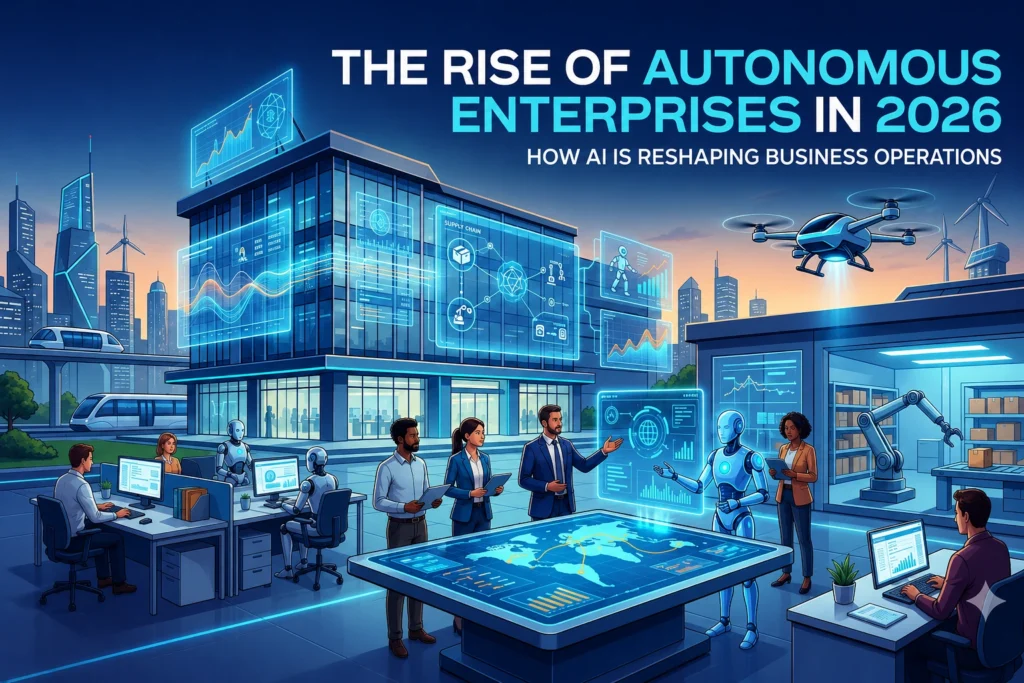
An autonomous enterprise uses artificial intelligence, automation, analytics, and connected systems to make decisions, execute workflows, and continuously improve operations with minimal human intervention.
For many organizations, this represents the next major competitive advantage.
What Is an Autonomous Enterprise?
An autonomous enterprise is an organization where business processes are largely managed through intelligent technologies rather than manual intervention.
These systems can:
- Analyze business data in real time
- Predict future outcomes
- Make operational decisions
- Execute workflows automatically
- Continuously optimize performance
Unlike traditional automation, which follows predefined rules, autonomous systems can adapt to changing conditions and learn from new information.
Think of it as the difference between:
- Automation: Following instructions.
- Autonomy: Understanding goals and deciding how to achieve them.
Why Autonomous Enterprises Are Emerging Now
Several technology trends have matured simultaneously.
Artificial Intelligence Has Become Practical
Modern AI systems can now:
- Process natural language
- Interpret images and video
- Analyze complex datasets
- Generate recommendations
- Automate decision-making
This enables businesses to automate not just tasks but entire decision processes.
Enterprise Data Is Growing Rapidly
Organizations generate enormous amounts of data from:
- CRM platforms
- ERP systems
- Customer interactions
- IoT devices
- Supply chain operations
- Financial transactions
The challenge is no longer collecting data.
The challenge is acting on it fast enough.
Autonomous systems solve this problem by making real-time decisions automatically.
Businesses Need Greater Efficiency
Economic uncertainty and increasing competition are pushing organizations to:
- Reduce operational costs
- Improve productivity
- Scale faster
- Deliver better customer experiences
Autonomous operations help achieve all four objectives simultaneously.
Core Technologies Behind Autonomous Enterprises
Autonomous organizations rely on multiple technologies working together.
Artificial Intelligence
AI provides:
- Prediction
- Pattern recognition
- Decision support
- Continuous learning
It serves as the intelligence layer of the enterprise.
Intelligent Automation
Automation systems execute tasks based on AI-generated insights.
This includes:
- Workflow automation
- Process orchestration
- System integrations
Real-Time Analytics
Modern analytics platforms process information continuously rather than relying solely on historical reports.
Businesses gain immediate visibility into operations and emerging risks.
Digital Twins
Digital twins provide virtual representations of business processes and systems.
Organizations can simulate scenarios before implementing changes in the real world.
Real-World Use Cases
Customer Service
Autonomous customer service systems can:
- Understand inquiries
- Retrieve information
- Resolve common issues
- Escalate complex cases
without human intervention.
This reduces response times and improves customer satisfaction.
Supply Chain Management
AI-driven systems can:
- Predict demand fluctuations
- Optimize inventory levels
- Identify supply disruptions
- Automatically adjust procurement strategies
This creates more resilient supply chains.
Financial Operations
Autonomous finance systems can:
- Detect anomalies
- Monitor compliance
- Approve transactions
- Generate forecasts
with minimal manual review.
Healthcare Administration
Healthcare organizations are using intelligent systems to:
- Schedule resources
- Optimize staffing
- Manage patient workflows
- Predict operational bottlenecks
This improves efficiency while reducing administrative burden.
Data Insight: The Business Impact
Organizations moving toward autonomous operations commonly report improvements in:
Productivity
Employees spend less time on repetitive administrative work.
Speed
Decisions happen in seconds rather than hours or days.
Accuracy
AI reduces many human errors in operational processes.
Scalability
Businesses can grow without increasing operational complexity at the same rate.
The result is greater efficiency and stronger competitiveness.
Autonomous Enterprise vs Traditional Enterprise
| Traditional Enterprise | Autonomous Enterprise |
|---|---|
| Human-driven decisions | AI-assisted decisions |
| Manual workflows | Intelligent workflows |
| Reactive operations | Predictive operations |
| Periodic optimization | Continuous optimization |
| Limited scalability | Dynamic scalability |
The shift is not about replacing people.
It is about allowing people to focus on higher-value work while intelligent systems manage operational complexity.
Challenges Organizations Must Address
Autonomous enterprises offer significant benefits, but implementation requires careful planning.
Data Quality
Poor data produces poor decisions.
Organizations must establish strong data governance practices.
Change Management
Employees must adapt to new ways of working alongside intelligent systems.
Successful transformation requires training and communication.
Security and Compliance
As more decisions become automated, businesses must ensure:
- Transparency
- Accountability
- Regulatory compliance
Trust becomes critical.
Industries Expected to Lead Adoption
Autonomous enterprise strategies are gaining momentum across:
- Healthcare
- Financial Services
- Manufacturing
- Logistics
- Retail
- SaaS Platforms
- Telecommunications
Any industry with complex workflows and large datasets can benefit significantly.
How Our Company Helps Businesses Become Autonomous
At our company, we help organizations build intelligent digital ecosystems that support autonomous operations.
Our expertise includes:
- AI solution development
- Enterprise automation
- Cloud-native architecture
- Data engineering
- Analytics platforms
- System integration
We help businesses transform from reactive organizations into intelligent, adaptive enterprises.
Final Thoughts
The autonomous enterprise represents the next phase of digital transformation.
Organizations are moving beyond software that simply stores information toward systems that can:
- Analyze
- Decide
- Execute
- Improve
As AI, automation, and analytics continue to mature, autonomous operations will become a defining characteristic of successful businesses.
The future enterprise will not simply be digital. It will be intelligent, adaptive, and increasingly autonomous.