
The Build vs Buy Dilemma in 2026: Why More Businesses Are Choosing Custom Software Over Off-the-Shelf Solutions
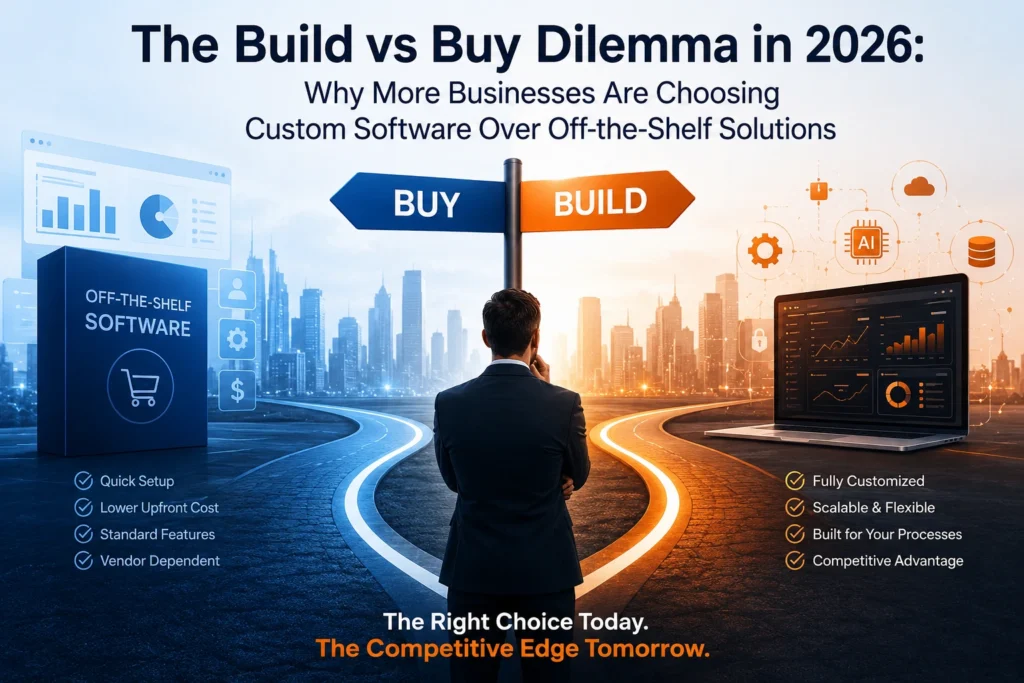
Build vs Buy Software in 2026: Making the Right Technology Investment
A Strategic Guide for Companies Planning Digital Transformation
When businesses decide to modernize operations, improve customer experiences, or launch new digital products, they face a critical decision:
Should we build custom software or buy an existing solution?
For years, off-the-shelf software dominated the market because it offered quick implementation and lower upfront costs.
However, in 2026, the conversation is changing.
As competition intensifies and customer expectations rise, organizations are discovering that generic software often limits innovation, scalability, and differentiation.
As a result, many businesses are investing in custom-built platforms tailored specifically to their operations and long-term goals.
The question is no longer:
“Which software should we buy?”
Instead, it has become:
“Which approach creates the greatest strategic advantage?”
Why This Decision Matters More Than Ever
Digital transformation is no longer optional.
Businesses depend on software for:
- Operations management
- Customer engagement
- Sales processes
- Data analytics
- Automation
- Decision-making
The wrong software decision can result in:
- Higher long-term costs
- Reduced productivity
- Limited scalability
- Poor customer experiences
Choosing the right strategy can directly impact growth and profitability for years.
Understanding Off-the-Shelf Software
Off-the-shelf software refers to pre-built solutions designed for a broad audience.
Examples include:
- CRM platforms
- ERP systems
- Accounting software
- Project management tools
- HR management systems
These products typically provide standardized features intended to meet common business needs.
Advantages of Buying Software
Faster Deployment
Implementation can often be completed within weeks rather than months.
This makes purchased solutions attractive for organizations needing immediate functionality.
Lower Initial Investment
Since development costs are shared across thousands of customers, upfront expenses are generally lower.
Proven Reliability
Established platforms have already undergone testing and refinement.
Businesses benefit from mature functionality and vendor support.
The Hidden Challenges of Off-the-Shelf Solutions
While convenient, pre-built systems often create long-term limitations.
Feature Overload
Many organizations pay for capabilities they never use.
This increases software costs while creating unnecessary complexity.
Limited Customization
Every business has unique workflows.
Generic software forces organizations to adapt processes around the software rather than the software adapting to the business.
Vendor Dependency
Organizations become dependent on:
- Vendor roadmaps
- Pricing structures
- Feature availability
- Support quality
This limits strategic flexibility.
Integration Complexity
As businesses adopt multiple systems, integration challenges often increase significantly.
Why Custom Software Is Gaining Momentum in 2026
Several market trends are accelerating demand for custom development.
Competitive Differentiation
In highly competitive industries, unique digital experiences can become major advantages.
Custom software allows businesses to create capabilities competitors cannot easily replicate.
AI and Automation Requirements
Modern businesses increasingly require:
- AI integrations
- Intelligent workflows
- Industry-specific automation
- Advanced analytics
Custom solutions make these capabilities easier to implement and optimize.
Scalability Needs
As organizations grow, operational complexity increases.
Custom platforms can evolve alongside business requirements without the limitations imposed by generic products.
The Business Case for Custom Development
Custom software is no longer viewed solely as a technology investment.
It is increasingly considered a strategic business asset.
Benefits include:
- Workflow Optimization – Software is built around actual business processes.
- Improved Productivity – Employees spend less time working around software limitations.
- Better Customer Experiences – Organizations can create personalized user journeys aligned with customer expectations.
- Long-Term Cost Control – Businesses avoid recurring licensing and customization expenses associated with multiple third-party systems.
Industries Driving Custom Software Demand
Healthcare
Healthcare organizations require solutions tailored to:
- Patient workflows
- Compliance requirements
- Clinical operations
- Telehealth services
Real Estate
Custom platforms help manage:
- Property listings
- Lead generation
- Agent operations
- Customer interactions
SaaS Businesses
Software companies require unique platforms that support:
- Product differentiation
- Subscription management
- User analytics
- Customer engagement
Manufacturing
Custom systems improve:
- Supply chain visibility
- Production planning
- Equipment monitoring
- Quality control
Build vs Buy: A Strategic Comparison
| Factor | Buy Software | Build Software |
|---|---|---|
| Initial Cost | Lower | Higher |
| Deployment Speed | Faster | Longer |
| Customization | Limited | Unlimited |
| Scalability | Vendor-dependent | Business-driven |
| Competitive Advantage | Low | High |
| Long-Term Flexibility | Limited | High |
| Ownership | Vendor-owned | Fully owned |
The right choice depends on business objectives, growth plans, and operational complexity.
When Buying Software Makes Sense
Organizations should consider purchasing solutions when:
- Requirements are standard
- Rapid deployment is critical
- Budgets are limited
- Differentiation is not a priority
Examples include:
- Payroll systems
- Accounting software
- Internal productivity tools
When Custom Software Is the Better Investment
Custom development becomes valuable when:
- Processes are unique
- Competitive advantage matters
- Long-term scalability is important
- Extensive integrations are required
- AI and automation are strategic priorities
For many growth-focused companies, custom platforms create lasting business value.
The Future: Hybrid Digital Strategies
An increasing number of organizations are adopting hybrid approaches.
They combine:
- Best-in-class commercial platforms
- Custom-built applications
- API integrations
- AI-powered services
This strategy balances speed, flexibility, and innovation.
How Our Company Helps Businesses Make the Right Choice
At our company, we help organizations evaluate technology investments based on business outcomes, not technology trends.
Our services include:
- Software consulting
- Custom application development
- Enterprise system integration
- AI-powered solutions
- Cloud-native architecture
- Digital transformation strategy
We help businesses choose solutions that support sustainable growth and long-term success.
Final Thoughts
The Build vs Buy decision is no longer simply an IT discussion.
It is a strategic business decision that affects:
- Innovation
- Efficiency
- Scalability
- Competitive positioning
As digital transformation accelerates, organizations that align technology decisions with business objectives will gain significant advantages.
In 2026, the most successful companies won’t necessarily use the most software.
They will use the software that best supports their unique vision, processes, and growth strategy.