
The Age of Intelligent Interfaces: Why Apps Will Soon Understand Users Instead of Waiting for Input
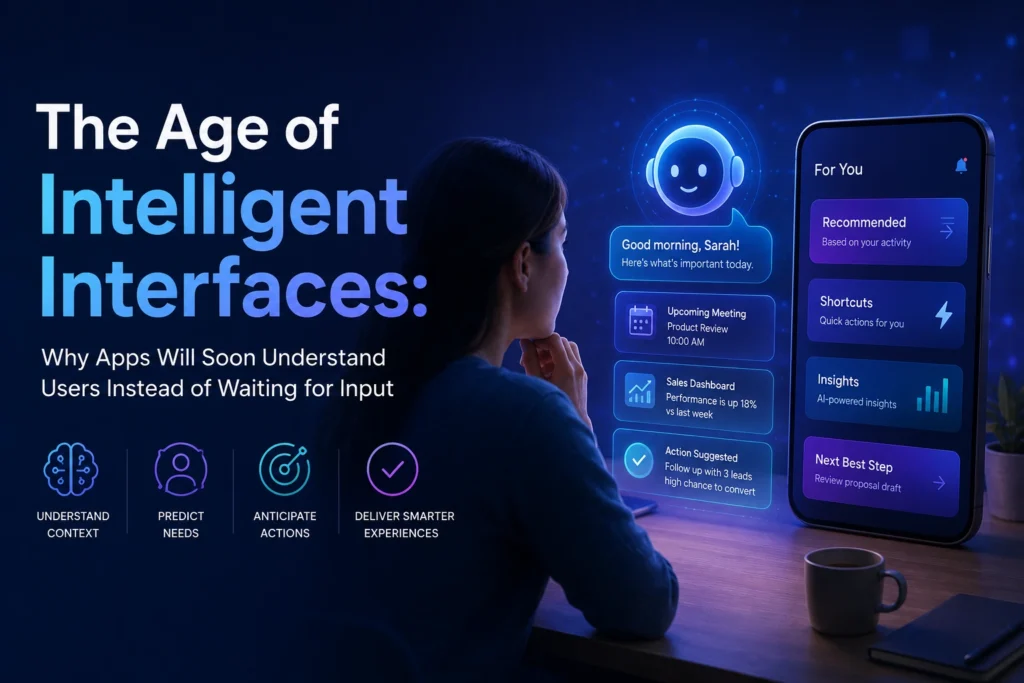
How AI Is Transforming User Experiences from Reactive Design to Predictive Interaction
For decades, software has followed a simple interaction model:
A user opens an application, searches for information, clicks buttons, fills out forms, and manually completes tasks.
Whether it was booking an appointment, shopping online, or accessing a business dashboard, the responsibility always rested with the user to navigate the interface and tell the application what to do.
This interaction model has shaped software design for more than 30 years.
But in 2026, a major shift is taking place.
Artificial Intelligence is changing the relationship between people and software. Instead of waiting for commands, modern applications are beginning to understand user behavior, predict intentions, and proactively offer the next best action.
This evolution is giving rise to Intelligent Interfaces, a new generation of applications that are context-aware, adaptive, and personalized.
Rather than reacting to user input, these systems anticipate needs before users even ask.
For businesses, this is more than a user experience trend. It is becoming a competitive advantage that improves customer satisfaction, operational efficiency, and digital engagement.
What Is an Intelligent Interface?
An intelligent interface is a user interface enhanced with AI, machine learning, and contextual awareness.
Unlike traditional interfaces that rely on explicit user actions, intelligent interfaces analyze multiple signals to determine what a user is likely trying to achieve.
These signals may include:
- Previous interactions
- Browsing behavior
- Device type
- Geographic location
- Time of day
- User preferences
- Business context
- Historical transactions
Using this information, the application dynamically adjusts its interface, recommendations, and workflows to reduce effort and improve outcomes.
Instead of asking users to search, filter, or navigate, intelligent interfaces surface the most relevant information automatically.
Why Intelligent Interfaces Are Trending in 2026
1. AI Models Have Become Context-Aware
Earlier AI systems responded only after receiving explicit instructions.
Today’s AI can interpret context, recognize patterns, and infer user intent.
For example:
- A healthcare application can recognize that a patient frequently schedules follow-up visits after receiving lab results and proactively suggest available appointments.
- A CRM platform can identify that a sales opportunity is approaching its renewal date and automatically display customer history and recommended actions.
- An e-commerce application can predict products a customer is likely to purchase based on seasonal trends and previous buying behavior.
This reduces friction and speeds up decision-making.
2. Businesses Are Prioritizing Experience Over Features
Research consistently shows that customers are more likely to remain loyal to products that are easy to use.
Today’s users value:
- Simplicity
- Speed
- Personalization
- Minimal effort
Organizations are realizing that a superior experience often creates greater competitive advantage than adding more features.
Intelligent interfaces support this goal by making interactions faster and more intuitive.
3. The Explosion of Behavioral Data
Every interaction generates valuable information.
Applications now collect insights from:
- Click patterns
- Search history
- Session duration
- Purchase behavior
- Navigation paths
- Device usage
- Customer support interactions
AI transforms this raw data into personalized experiences that continuously improve over time.
From Reactive Interfaces to Predictive Experiences
Traditional software waits for users to take action.
Intelligent software predicts what users are trying to accomplish.
| Traditional Interface | Intelligent Interface |
|---|---|
| User searches manually | AI suggests relevant information |
| Static dashboards | Personalized dashboards |
| Generic navigation | Context-aware navigation |
| One experience for all users | Individualized experiences |
| Manual workflows | AI-assisted workflows |
The goal is not to remove user control but to eliminate unnecessary effort.
Real-World Applications Across Industries
Healthcare
Healthcare organizations are using intelligent interfaces to improve patient engagement and clinical efficiency.
Examples include:
- Recommending appointment slots based on patient history.
- Displaying personalized health reminders.
- Prioritizing urgent notifications for clinicians.
- Guiding patients through treatment plans.
These improvements help reduce administrative burden while enhancing patient experiences.
SaaS Platforms
Modern SaaS products increasingly personalize the experience for every customer.
AI can:
- Recommend relevant features.
- Highlight unused capabilities.
- Detect onboarding challenges.
- Offer contextual tutorials.
This improves user adoption and customer retention.
Retail and E-Commerce
Retail businesses are moving beyond simple product recommendations.
Intelligent interfaces can:
- Predict shopping intent.
- Personalize homepages.
- Adjust promotions based on customer behavior.
- Recommend complementary products in real time.
The result is higher conversion rates and more satisfying shopping experiences.
Enterprise Applications
Employees spend significant time searching for information across multiple systems.
Intelligent enterprise interfaces reduce this complexity by:
- Displaying relevant reports automatically.
- Suggesting next actions.
- Prioritizing approvals.
- Surfacing critical business insights.
This enables employees to focus on decision-making rather than navigation.
Technologies Behind Intelligent Interfaces
Artificial Intelligence
AI interprets user behavior and generates personalized recommendations.
Machine Learning
Machine learning models continuously improve predictions based on new interactions.
Natural Language Processing (NLP)
Users increasingly communicate with applications using conversational language rather than complex menus.
Computer Vision
Visual recognition enables applications to understand images, documents, and real-world environments.
Real-Time Analytics
Applications process user behavior instantly, allowing interfaces to adapt during active sessions rather than after they end.
Business Benefits of Intelligent Interfaces
Organizations implementing intelligent interfaces report improvements in several key areas.
Improved Customer Satisfaction
Users complete tasks faster with less effort.
Higher Engagement
Personalized experiences encourage longer and more meaningful interactions.
Increased Productivity
Employees spend less time navigating software and more time completing valuable work.
Better Conversion Rates
Relevant recommendations improve purchasing decisions and customer retention.
Reduced Support Costs
Context-aware guidance decreases the need for customer assistance.
Challenges Organizations Must Address
Privacy and Trust
Personalization depends on responsible data collection.
Organizations must clearly explain:
- What information is collected.
- Why it is collected.
- How it is protected.
Transparency builds user trust.
Avoiding Over-Automation
AI should assist users, not overwhelm them.
The best intelligent interfaces enhance decision-making while preserving user control.
Users should always have the ability to override AI recommendations.
Data Quality
Predictions are only as reliable as the underlying data.
Incomplete or inaccurate data can reduce the effectiveness of personalization.
Organizations should invest in strong data governance practices before implementing AI-driven interfaces.
The Future: Interfaces That Learn Continuously
Over the next few years, intelligent interfaces are expected to evolve even further.
Future applications may:
- Adapt layouts automatically based on user behavior.
- Detect frustration and simplify workflows.
- Coordinate tasks across multiple applications.
- Anticipate business needs before users recognize them.
- Deliver proactive insights without requiring manual searches.
Eventually, software may become less about navigation and more about collaboration.
Applications will function as intelligent assistants rather than passive tools.
How Our Company Builds Intelligent User Experiences
At [Your Company Name], we help organizations design next-generation applications that combine AI with exceptional user experience.
Our expertise includes:
- AI-powered application development
- Custom web and mobile applications
- Healthcare software solutions
- SaaS platform development
- Enterprise software modernization
- UX/UI strategy and design
- Predictive analytics integration
- Cloud-native application architecture
Our goal is to build software that doesn’t just respond to users. It understands them.
By combining intelligent automation with human-centered design, we help businesses create digital experiences that are faster, smarter, and more engaging.
Final Thoughts
The era of passive software is coming to an end.
As AI becomes more sophisticated, users will increasingly expect applications to understand context, anticipate needs, and simplify complex tasks.
Organizations that invest in intelligent interfaces today will be better positioned to deliver exceptional customer experiences, improve operational efficiency, and differentiate themselves in an increasingly competitive digital landscape.
The future of software is not just about beautiful design or powerful features.
It is about creating applications that think alongside their users.