
Spatial Computing in 2026: How Businesses Are Blending Digital and Physical Reality
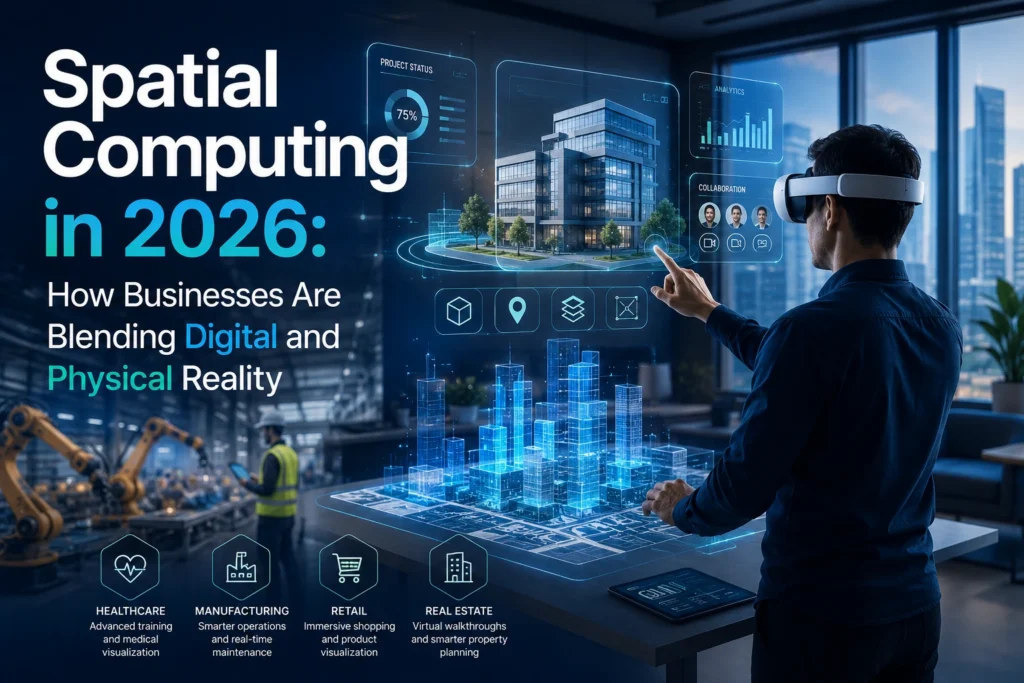
Spatial Computing in 2026: The Future Beyond Screens
The Technology Shift Beyond Screens Into Immersive Intelligent Environments
For decades, digital interaction has happened primarily through screens.
People worked, communicated, shopped, and consumed information using:
- Smartphones
- Laptops
- Tablets
- TVs
But in 2026, computing is beginning to move beyond traditional screens into immersive, interactive environments where digital content exists naturally within physical space.
This transformation is driving one of the most important emerging technology trends:
Spatial Computing
Spatial computing is redefining how humans interact with technology by merging digital experiences with the physical world through intelligent 3D environments.
What Is Spatial Computing?
Spatial computing refers to technologies that allow computers to:
- Understand physical space
- Interact with real-world environments
- Blend digital content into physical surroundings
- Enable natural human interaction through movement, gestures, voice, and positioning
Instead of interacting only through flat interfaces, users engage with immersive digital objects and environments around them.
Computing becomes spatial, contextual, and environment-aware.
Technologies Powering Spatial Computing
Spatial computing combines multiple advanced technologies, including:
- Artificial Intelligence (AI)
- Augmented Reality (AR)
- Virtual Reality (VR)
- Mixed Reality (MR)
- Computer Vision
- IoT systems
- 3D rendering engines
- Real-time spatial mapping
Together, these technologies create immersive and interactive digital environments.
Why Spatial Computing Is Trending in 2026
1. Advances in AR & Mixed Reality Devices
Modern hardware is becoming significantly more powerful and user-friendly.
Devices now offer:
- Improved spatial tracking
- High-resolution immersive displays
- Real-time environmental mapping
- Better wearable comfort
This makes spatial experiences more practical for business applications.
2. Demand for More Natural Human–Technology Interaction
Traditional interfaces create limitations.
Businesses are now exploring interaction models based on:
- Gestures
- Voice
- Eye tracking
- Physical movement
The goal is to create more intuitive and immersive user experiences.
3. Growth of Digital Twins & 3D Collaboration
Organizations increasingly rely on:
- Real-time simulations
- Remote collaboration
- Interactive 3D visualization
Spatial computing enables users to interact with digital systems in ways that closely resemble physical-world experiences.
How Spatial Computing Works
Spatial computing systems continuously map and interpret physical environments using sensors and AI.
These systems analyze:
- Depth
- Positioning
- Motion
- Object recognition
- User interaction
Digital elements are then anchored within real-world spaces in real time.
This enables experiences where digital content behaves like physical objects.
Real-World Business Use Cases
Healthcare & Medical Training
Spatial systems are helping healthcare organizations with:
- Surgical simulation
- Medical visualization
- Remote collaboration
- Interactive anatomy learning
Doctors can interact with 3D medical models in immersive environments.
Manufacturing & Industrial Operations
Factories use spatial computing for:
- Equipment visualization
- Remote maintenance support
- Worker training
- Real-time operational monitoring
This improves efficiency and reduces operational errors.
Retail & E-Commerce
Retailers are adopting immersive experiences such as:
- Virtual product visualization
- AR shopping experiences
- Interactive showrooms
Customers can preview products inside their physical environments before purchasing.
Real Estate & Architecture
Spatial computing enables:
- Virtual property walkthroughs
- 3D architectural visualization
- Interactive construction planning
This improves client communication and project planning.
Technologies and Platforms Leading the Market
Major technology companies are heavily investing in spatial computing ecosystems such as:
- Apple Vision Pro
- Microsoft Mesh
- Unity
These platforms are accelerating enterprise adoption of immersive technologies.
Data Insight: Why Businesses Are Investing in Spatial Computing
Organizations adopting immersive technologies are reporting improvements in:
- User engagement
- Training effectiveness
- Operational visualization
- Collaboration efficiency
- Product presentation experiences
Spatial interaction creates more intuitive and emotionally engaging digital experiences.
Spatial Computing vs Traditional Computing
| Traditional Computing | Spatial Computing |
|---|---|
| Screen-based interaction | Environment-based interaction |
| Mouse & keyboard input | Gesture, voice, and motion input |
| Flat interfaces | Immersive 3D experiences |
| Separate digital world | Blended physical + digital world |
Spatial computing transforms computing from “device interaction” into “environment interaction.”
The Role of AI in Spatial Computing
Artificial intelligence is becoming central to spatial environments.
AI enables systems to:
- Recognize objects
- Understand spatial context
- Predict user behavior
- Personalize immersive experiences
As AI improves, spatial systems will become increasingly adaptive and intelligent.
Challenges Businesses Must Address
Despite its enormous potential, spatial computing also introduces important challenges.
Hardware Costs
Advanced immersive devices remain expensive for large-scale deployment.
Content Development Complexity
Creating interactive 3D environments requires specialized expertise in:
- Design
- Development
- Real-time rendering
- Spatial UX
Privacy & Data Concerns
Spatial systems collect highly sensitive environmental and behavioral data.
Organizations must implement strong governance and security strategies.
The Future: Beyond Screens
Spatial computing represents a long-term shift in how humans interact with technology.
In the future:
- Interfaces may disappear into environments
- Workspaces may become immersive
- Collaboration may happen in shared virtual spaces
- Digital objects may coexist naturally with physical surroundings
This evolution is moving computing toward:
Persistent, intelligent, immersive digital environments.
How Our Company Helps Businesses Build Immersive Digital Experiences
At our company, we help organizations develop scalable spatial computing solutions for next-generation digital transformation.
Our expertise includes:
- AR/VR application development
- Real-time 3D systems
- Interactive digital experiences
- Immersive enterprise solutions
We help businesses create platforms that are:
- ✅ Immersive
- ✅ Intelligent
- ✅ Scalable
- ✅ Future-ready
Final Thoughts
Spatial Computing is becoming one of the most transformative technology trends shaping the future of digital interaction.
As AI, AR, and immersive technologies continue evolving, businesses will increasingly move beyond traditional screens into intelligent spatial environments.
Organizations that invest early in spatial technologies will gain significant advantages in:
- Customer engagement
- Training and collaboration
- Product visualization
- Digital innovation
The future of computing is no longer confined to screens — it is becoming part of the space around us.