
Headless Commerce in 2026: Why Modern E-commerce Is Moving Beyond Traditional Platforms
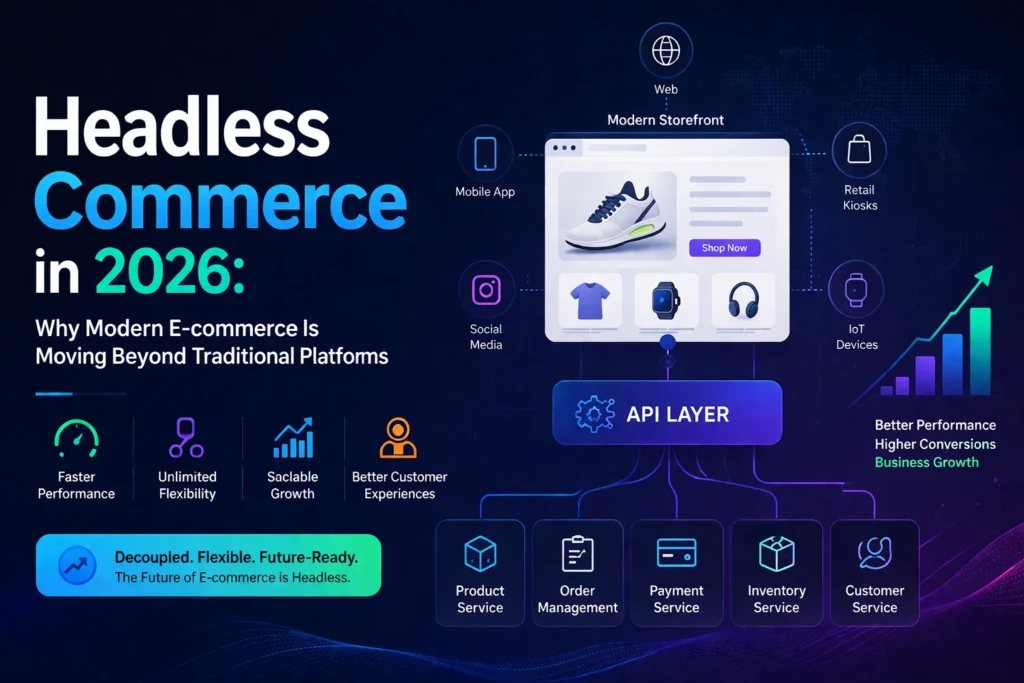
Headless Commerce in 2026: Why Modern E-commerce Is Moving Beyond Traditional Platforms
A Data-Driven Look at Flexibility, Performance, and Scalability
E-commerce has evolved rapidly over the last decade — but in 2026, a major architectural shift is redefining how online businesses operate:
Headless Commerce.
Traditional e-commerce platforms are no longer able to meet the growing demands of speed, personalization, and omnichannel experiences.
As a result, businesses are moving toward a more flexible, API-driven approach.
This blog explores what headless commerce is, why it’s trending, and how it delivers measurable business impact.
What Is Headless Commerce?
In a traditional e-commerce system, the frontend (what users see) and the backend (where data and logic live) are tightly connected.
Headless commerce separates these two layers.
The frontend communicates with the backend via APIs, allowing businesses to build completely custom user experiences without being restricted by backend limitations.
Why Traditional E-commerce Is Struggling
Legacy platforms often create bottlenecks such as:
- Limited design flexibility
- Slow performance due to monolithic architecture
- Difficulty integrating new technologies
- Poor omnichannel support
For example, updating the user interface in a traditional system may require backend changes — slowing down innovation.
The Shift Toward Headless Architecture
Headless commerce solves these challenges by introducing decoupled architecture.
This means:
- Frontend teams can innovate independently
- Backend systems remain stable and scalable
- New channels (mobile, web, IoT) can be added easily
Platforms like Shopify (with headless capabilities) and Contentful are enabling this transformation.
Key Business Drivers Behind the Trend
1. Demand for Omnichannel Experiences
Customers interact with brands across:
- Websites
- Mobile apps
- Social media
- Smart devices
Headless commerce allows businesses to deliver a consistent experience across all channels.
2. Need for Speed & Performance
Page speed directly impacts conversions.
Studies consistently show:
- Even a 1-second delay can reduce conversions significantly
- Faster sites improve SEO rankings and user engagement
Headless architecture enables lightweight, optimized frontends — improving performance.
3. Personalization at Scale
Modern consumers expect personalized experiences.
Headless systems allow integration with analytics and personalization tools, enabling:
- Dynamic content
- Product recommendations
- Custom user journeys
Data Insight: Business Impact of Headless Commerce
Companies adopting headless commerce report:
- 20–40% improvement in website performance
- Higher conversion rates due to better UX
- Faster deployment of new features
- Improved scalability during high traffic
The architecture directly impacts revenue and user engagement.
Key Components of a Headless Commerce Stack
- Frontend Layer: Custom UI built using modern frameworks
- Backend Commerce Engine: Handles products, orders, and transactions
- APIs: Connect frontend and backend systems
- CMS (Content Management System): Manages content independently
Real-World Use Case
Traditional Approach:
- Website and backend tightly coupled
- Slow updates and limited flexibility
Headless Approach:
- Custom frontend for web and mobile
- Backend handles transactions via APIs
- Easy integration with marketing tools
Result: Faster updates, better UX, increased conversions.
Challenges to Consider
- Higher initial development complexity
- Need for skilled developers
- Requires strong API management
It’s best suited for businesses aiming for scalability and long-term growth.
When Should Businesses Choose Headless Commerce?
- You want full control over user experience
- You operate across multiple channels
- You need high scalability
- You plan frequent UI/UX updates
How Our Company Helps Build Headless Commerce Solutions
At our company, we help businesses transition from traditional systems to modern, scalable architectures.
Our services include:
- Headless commerce development
- API integration
- Custom frontend development
- Performance optimization
We build solutions that are fast, flexible, and future-ready.
Final Thoughts
Headless commerce is not just a trend — it’s a fundamental shift in how e-commerce systems are built.
In 2026, businesses that adopt this approach will:
- Deliver better customer experiences
- Innovate faster
- Scale without limitations
The future of e-commerce is not just digital — it’s decoupled, flexible, and API-driven.