
Event-Driven Architecture in 2026: A Practical Business Guide
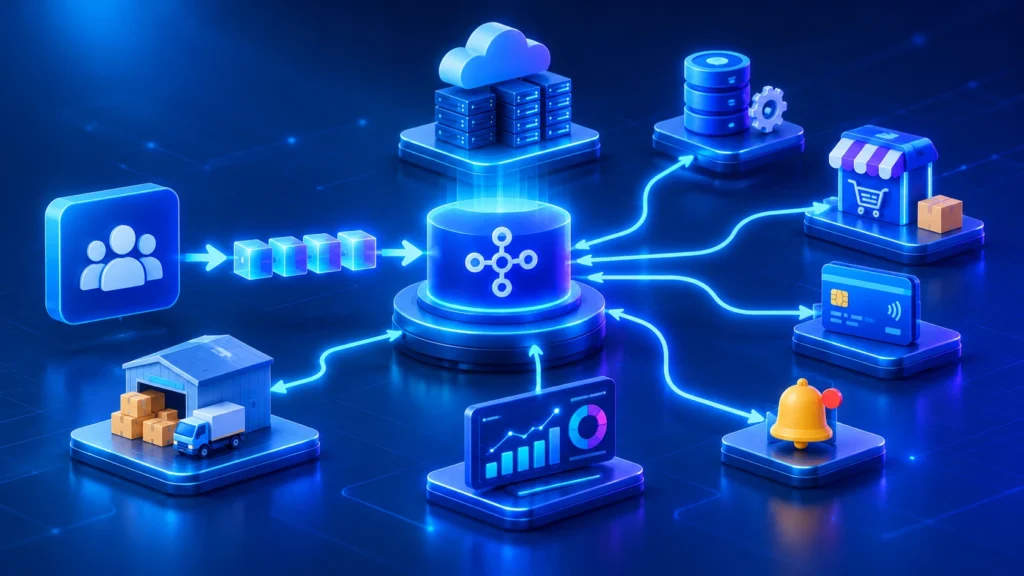
Event-Driven Architecture: Building Responsive and Scalable Business Applications in 2026
Modern business applications rarely work in isolation. An ecommerce platform may need to update inventory, process payments, send order confirmations, notify a warehouse, and refresh customer records whenever a purchase is completed. A healthcare platform may need to coordinate appointments, notifications, payments, and patient workflows across multiple systems.
When every service depends on another service responding immediately, even a small delay can affect the entire workflow. As applications become more connected, businesses need a reliable way for different parts of their systems to communicate without creating unnecessary dependencies.
Event-driven architecture offers one approach. It allows applications to respond to important business events and process related work independently. In 2026, it is an important architectural pattern for organizations building scalable platforms, connected services, and responsive digital experiences.
What Is Event-Driven Architecture?
Event-driven architecture (EDA) is a software design approach in which components communicate by producing and responding to events.
An event represents something that has happened in a system. Examples include:
- A customer places an order.
- A payment is successfully completed.
- A user creates a new account.
- A product’s inventory level changes.
- A document is uploaded.
- A delivery status is updated.
Instead of requiring one service to directly call every other service, the application publishes an event. Other components that are interested in that event can receive it and perform their own tasks.
For example, after an order is placed, separate services can process payment confirmation, inventory updates, email notifications, analytics, and shipping preparation. These activities do not all need to happen inside the same request.
This approach can reduce tight coupling between services and make it easier to add new capabilities as a business application grows.
How Does Event-Driven Architecture Work?
A typical event-driven system has three main components: event producers, an event broker, and event consumers.
1. Event Producers
Producers are application components that publish events when something important happens. A checkout service, for example, may publish an OrderPlaced event after validating a customer’s order.
2. Event Broker
The event broker receives and routes messages to the appropriate consumers. Depending on the technology and design, it may support message queues, publish-subscribe communication, event retention, retries, and delivery controls.
3. Event Consumers
Consumers are services or processes that subscribe to events and perform related work. An inventory service may update stock, while a notification service sends an order confirmation.
A Simple Example
Consider an online store. When a customer completes checkout, the order service publishes an event. Other services respond independently:
- The inventory service reserves the purchased products.
- The notification service sends an order confirmation.
- The shipping service prepares the fulfillment request.
- The analytics service records the purchase.
- The customer account service updates the order history.
The checkout service does not need to manage every downstream operation directly. This separation makes it easier to maintain and extend the system.
Why Businesses Are Adopting Event-Driven Systems in 2026
Applications increasingly need to coordinate activity across internal services, external platforms, cloud infrastructure, and connected devices. Traditional request-response communication remains useful, but it is not always the best choice for every workflow.
Recent industry coverage reflects this shift. Vercel’s July 2026 engineering article discusses how teams can choose appropriate asynchronous tools for different workloads rather than introducing unnecessary infrastructure. n8n’s August 2026 guide also highlights the benefits and tradeoffs of event-driven microservices in production.
Gartner’s June 2026 data and analytics trends identify continuous, event-driven data flows as an important foundation for real-time intelligence and responsive operations.
For businesses, the value is not simply adopting a newer architecture. It is making systems more adaptable when workloads, integrations, and customer expectations change.
Key Benefits of Event-Driven Architecture
1. Looser Coupling Between Services
In a tightly coupled system, one service may need to know the location and behavior of several other services. Changes to one component can require changes across the application.
With event-driven communication, producers publish events without needing to know every consumer. New services can subscribe to relevant events without requiring major changes to the original producer.
This can make applications easier to extend as business requirements evolve.
2. Better Scalability
Different services often experience different levels of demand. An order-processing service may receive a sudden increase in activity, while reporting and notification services have different workload patterns.
Event-driven systems allow consumers to scale according to their own processing requirements. Teams can add more workers to handle a growing queue without necessarily scaling every other part of the application.
3. Improved Resilience
In a direct request-response workflow, a downstream service failure can interrupt the original operation. Asynchronous messaging can reduce this dependency by allowing work to be accepted and processed separately.
Queues, retries, timeouts, and failure-handling mechanisms help services recover from temporary issues. However, these protections must be designed and configured properly.
4. Faster Background Processing
Some tasks do not need to finish before a user receives a response. Sending emails, generating reports, processing uploaded files, updating analytics, and synchronizing external systems can often happen in the background.
Moving these tasks out of the main request can help keep user-facing workflows responsive.
5. Easier Integration With External Systems
Businesses often connect applications to payment gateways, CRM platforms, accounting systems, shipping providers, and communication tools.
Events and webhooks can help these systems exchange information when something changes. A well-designed integration layer can reduce the need for every application to maintain direct dependencies on every external service.
6. Support for Real-Time Business Operations
When events are processed continuously, applications can respond to changes without waiting for a scheduled batch process.
This can support use cases such as inventory alerts, fraud monitoring, shipment updates, operational dashboards, and notifications triggered by customer activity.
Event-Driven Architecture vs. Traditional Request-Response Systems
Both approaches are useful. The right choice depends on how quickly a response is required and how the business workflow should behave.
| Area | Request-Response | Event-Driven |
|---|---|---|
| Communication | A service requests work from another service and waits for a response. | A producer publishes an event for interested consumers. |
| Dependency | Services are often more directly connected. | Services can operate more independently. |
| Processing | Often suitable for immediate interactions. | Well suited to asynchronous and background tasks. |
| Failure handling | Failures may affect the calling request. | Queues and retries can help isolate temporary failures. |
| Complexity | Usually simpler for small workflows. | Requires additional monitoring and message management. |
| Typical use cases | Login, search, data retrieval, and immediate validation. | Notifications, analytics, background jobs, and system integrations. |
Most modern applications benefit from a hybrid approach. Synchronous APIs handle interactions that require immediate feedback, while asynchronous events coordinate work that can happen independently.
Common Use Cases Across Industries
Ecommerce and Retail
When a customer places an order, events can trigger inventory updates, payment workflows, shipping requests, customer notifications, and sales reporting. Each process can be handled by a separate component.
Healthcare Platforms
Appointment bookings, reminders, payment confirmations, document processing, and status updates can be coordinated through events. Systems handling healthcare information must also apply appropriate privacy, access control, and audit requirements.
Financial Services
Financial applications can use event streams to process transaction updates, monitor account activity, trigger risk checks, and update reporting systems. These workflows require careful attention to security, ordering, auditability, and data consistency.
Logistics and Supply Chain
Shipment status changes, warehouse activity, inventory movement, and delivery updates can be published as events. Different systems can react to these changes without depending on one central application to coordinate every step.
SaaS Platforms
SaaS products can use events for user onboarding, subscription changes, usage tracking, billing workflows, integrations, and notifications. This can help teams add features without placing every responsibility inside the core application.
IoT and Connected Devices
Connected devices can generate events when sensors detect changes in temperature, location, equipment status, or other measurements. Event processing can help businesses trigger alerts and operational responses when defined conditions occur.
Important Technologies and Patterns
Message Queues
Message queues are useful when a task needs to be delivered to a worker for processing. They are commonly used for background jobs, notifications, and work distribution.
Examples include Amazon Simple Queue Service (SQS), RabbitMQ, and Azure Service Bus.
Publish-Subscribe Messaging
Publish-subscribe messaging allows multiple consumers to receive events from a shared topic or channel. It is useful when several systems need to react independently to the same business event.
Event Streaming Platforms
Event streaming platforms support continuous event flows, multiple consumers, and, depending on the platform, event retention and replay. They can be useful for analytics, monitoring, and high-volume event processing.
Apache Kafka and cloud-based streaming services are examples of technologies used for these workloads.
Webhooks
Webhooks allow one system to notify another system when a particular event occurs. They are commonly used to connect payment providers, CRM systems, ecommerce platforms, and other external services.
Workflow Orchestration
Some business processes involve several steps, delays, approvals, retries, and external integrations. Workflow orchestration tools can help coordinate these processes and provide visibility into their execution.
Challenges Businesses Should Understand
Event-driven architecture can improve flexibility, but it also introduces design and operational responsibilities. Businesses should understand these challenges before choosing this approach.
1. Eventual Consistency
In an asynchronous system, different services may update their data at different times. An order may be created before the inventory service has finished updating its records.
Applications should clearly define which information must be immediately consistent and which operations can tolerate a short delay. User interfaces should communicate processing states accurately.
2. Duplicate Event Delivery
Messaging systems may deliver the same event more than once, depending on their delivery guarantees and failure conditions. Consumers should be designed to handle duplicate messages safely.
Idempotent processing helps ensure that receiving an event more than once does not accidentally create duplicate payments, orders, or other business actions.
3. Event Ordering
Some workflows depend on events being processed in a particular sequence. For example, an order cancellation should not be processed as if it happened before the original order was created.
Teams should understand the ordering guarantees of their messaging technology and design workflows to handle out-of-order events where necessary.
4. Monitoring and Debugging
In a system with multiple asynchronous services, a single business action can travel through many components. Finding the source of a failure can be difficult without proper tracing and logging.
Use correlation IDs, structured logs, distributed tracing, queue monitoring, and clear event execution records to understand how work moves through the system.
5. Message Failure and Recovery
Some events may fail because of temporary service outages, invalid data, or unavailable dependencies. Applications need retry policies, timeouts, failure queues, and processes for investigating messages that cannot be processed successfully.
6. Additional Infrastructure Complexity
Message brokers, event schemas, monitoring systems, and deployment processes introduce additional components to operate and maintain. For small applications, this complexity may outweigh the benefits.
Best Practices for Implementing Event-Driven Architecture
- Start with clear business events: Use meaningful names such as
OrderPlaced,PaymentCompleted, andShipmentDispatched. - Keep event payloads purposeful: Include the information consumers need without unnecessarily exposing sensitive or excessive data.
- Design consumers to be idempotent: Make repeated event processing safe.
- Define retry and failure policies: Decide how temporary errors, invalid messages, and repeated failures should be handled.
- Version event schemas carefully: Changes to event structures should not unexpectedly break existing consumers.
- Secure event communication: Apply authentication, authorization, encryption, and appropriate access controls.
- Monitor the complete workflow: Track event production, delivery, processing time, failures, and queue backlogs.
- Use synchronous APIs where appropriate: Do not force every operation into an asynchronous model.
- Document event ownership: Make it clear which service publishes an event and which services consume it.
How to Decide Whether Your Business Needs Event-Driven Architecture
Event-driven architecture is not automatically the right solution for every application. The decision should be based on business requirements, workload patterns, and the complexity of existing systems.
It May Be a Good Fit When:
- Several services need to react to the same business action.
- Background processing is slowing down user-facing requests.
- Workloads have unpredictable peaks and need independent scaling.
- Applications need to integrate with multiple external platforms.
- Different teams need to develop and deploy services independently.
- Business processes involve multiple steps that can run asynchronously.
A Simpler Architecture May Be Better When:
- The application is small and has only a few components.
- Most operations require immediate results.
- There are few integrations or background tasks.
- The team does not have the operational capacity to manage additional infrastructure.
- Direct function calls or a simple job queue already solve the problem.
A practical approach is to introduce asynchronous processing where it solves a real problem, then expand the architecture as the product and its requirements grow.
A Practical Roadmap for Adoption
Step 1: Map Existing Business Workflows
Identify the processes that connect multiple services. Look for workflows with repeated API calls, slow background operations, or unnecessary dependencies.
Step 2: Select One Suitable Use Case
Start with a contained workflow such as sending notifications, processing uploaded files, or updating analytics after an order is completed.
Step 3: Define Events and Responsibilities
Specify what each event means, which service publishes it, which consumers need it, and what data should be included.
Step 4: Choose the Right Messaging Technology
Select a queue, publish-subscribe system, event stream, or webhook approach based on delivery requirements, workload volume, retention, ordering, and operational complexity.
Step 5: Build Reliability Into the Workflow
Implement retries, idempotency, error handling, schema management, security controls, and monitoring before expanding to critical business processes.
Step 6: Measure the Results
Evaluate processing time, application responsiveness, failure rates, operational overhead, and the effort required to add new integrations. Expand the approach only when it provides measurable value.
Conclusion
Event-driven architecture gives businesses a flexible way to connect application components and respond to changes across digital systems. By separating event producers from consumers, organizations can build workflows that are easier to extend and scale when implemented with the right controls.
However, the architecture also introduces responsibilities around message delivery, data consistency, event ordering, monitoring, and recovery. These considerations should be part of the design from the beginning.
The most effective approach is not to make every application event-driven. It is to identify where asynchronous communication solves real business problems and introduce it where the benefits justify the additional complexity.
With thoughtful design and implementation, event-driven systems can help businesses build more responsive, maintainable, and adaptable software products.
How Expoders Can Help
At Expoders, we help businesses design, develop, integrate, and scale web applications, SaaS platforms, APIs, and custom software solutions.
Whether you are building a new digital product, connecting existing systems, or improving application architecture, our team can help evaluate the right technical approach for your business requirements.
Connect with Expoders to discuss your next software development project.