
Digital Twins Beyond Manufacturing: How Virtual Business Models Are Transforming Every Industry
Digital Twins: How Virtual Replicas Are Reshaping Business Decision-Making in 2026
For years, the concept of a digital twin was associated primarily with manufacturing.
Factories created virtual models of machines to monitor performance, predict failures, and optimize production.
But in 2026, the definition of digital twins has expanded dramatically.
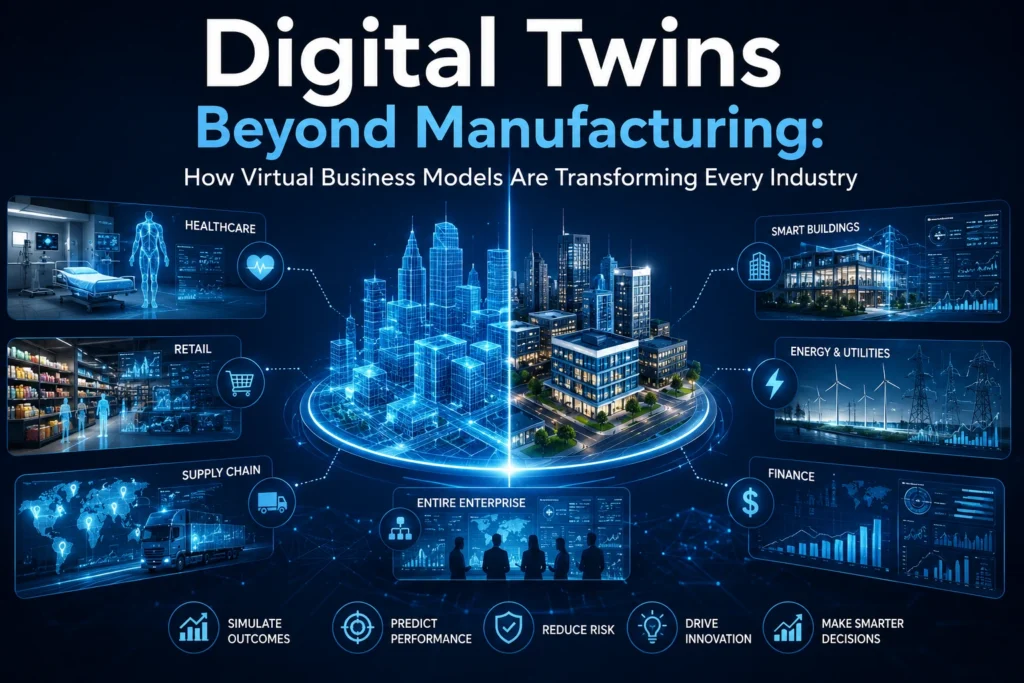
Today, businesses are creating digital replicas of:
- Customers
- Supply chains
- Hospitals
- Buildings
- Cities
- Retail operations
- Business processes
- Entire enterprises
These virtual models allow organizations to test decisions, predict outcomes, and optimize performance before making real-world changes.
As a result, Digital Twins are emerging as one of the most powerful technologies driving the next wave of digital transformation.
What Is a Digital Twin?
A Digital Twin is a virtual representation of a real-world object, system, process, or environment that continuously updates using real-time data.
Unlike traditional simulations, digital twins are connected to live operational data.
This means they can:
- Reflect current conditions
- Predict future scenarios
- Identify risks
- Recommend optimizations
Think of a digital twin as a living digital replica that evolves alongside the real-world system it represents.
Why Digital Twins Are Trending in 2026
AI and Predictive Analytics
Modern AI systems can analyze enormous amounts of operational data and generate insights from digital twin environments.
Businesses can now simulate thousands of possible outcomes before taking action.
IoT Expansion
Connected devices generate continuous streams of operational data.
This data powers digital twins by providing real-time visibility into physical systems.
Cloud Computing Maturity
Scalable cloud infrastructure allows organizations to process and store the massive data volumes required for digital twin environments.
Demand for Better Decision-Making
Business leaders increasingly need tools that reduce uncertainty.
Digital twins help organizations evaluate decisions before implementing them in the real world.
The Evolution of Digital Twins
| Generation | Focus |
|---|---|
| First Generation | Machine and equipment monitoring |
| Second Generation | Factory and production optimization |
| Third Generation | Business process simulation |
| Fourth Generation (2026) | Enterprise-wide digital twins capable of modeling entire organizations |
This evolution is creating new opportunities across virtually every industry.
Healthcare Digital Twins
Healthcare organizations are moving beyond traditional patient records.
Digital twins can help model:
- Patient journeys
- Hospital operations
- Resource allocation
- Treatment planning
Imagine a hospital creating a digital twin of its emergency department to predict patient flow and optimize staffing before peak demand occurs.
Benefits include:
- Reduced wait times
- Improved resource utilization
- Better patient outcomes
Real Estate and Smart Buildings
Property developers and facility managers use digital twins to manage:
- Energy consumption
- Building performance
- Occupancy trends
- Maintenance planning
Rather than reacting to problems, organizations can predict and prevent them.
This significantly reduces operational costs.
Retail and Customer Experience
Retailers are beginning to create digital twins of customer behavior.
These models help organizations understand:
- Purchasing patterns
- Customer journeys
- Store performance
- Demand fluctuations
Businesses can test marketing campaigns virtually before launching them.
Supply Chain Digital Twins
Supply chains have become increasingly complex.
Digital twins help organizations simulate:
- Inventory shortages
- Transportation disruptions
- Supplier failures
- Demand spikes
This improves resilience and reduces operational risk.
Enterprise Digital Twins
One of the fastest-growing trends is the creation of digital twins for entire organizations.
Enterprise digital twins model:
- Workflows
- Financial performance
- Human resources
- Operations
- Customer interactions
Executives gain a virtual environment for testing strategic decisions before implementation.
Technologies Powering Digital Twins
Several advanced technologies work together to enable digital twin environments.
These include:
- Artificial Intelligence
- Machine Learning
- IoT Sensors
- Cloud Computing
- Big Data Analytics
- Real-Time Visualization
Popular enterprise platforms include:
- Microsoft Azure Digital Twins
- Siemens Xcelerator
- NVIDIA Omniverse
These platforms allow organizations to create highly detailed digital representations of real-world systems.
Data Insight: Why Businesses Are Investing
Organizations implementing digital twin strategies frequently report improvements in:
Operational Efficiency
Businesses identify bottlenecks before they affect performance.
Cost Reduction
Predictive insights reduce unnecessary spending and downtime.
Risk Management
Leaders can evaluate scenarios before making decisions.
Innovation Speed
New products, services, and processes can be tested virtually.
The result is better decision-making with lower risk.
Digital Twins vs Traditional Analytics
| Traditional Analytics | Digital Twins |
|---|---|
| Historical reporting | Real-time modeling |
| Reactive insights | Predictive insights |
| Limited scenario testing | Extensive simulation capabilities |
| Static dashboards | Dynamic virtual environments |
Digital twins move organizations from understanding what happened to understanding what is likely to happen next.
Challenges Businesses Must Address
Data Quality
Digital twins are only as accurate as the data feeding them.
Poor data quality limits effectiveness.
Integration Complexity
Organizations often need to connect multiple systems, applications, and data sources.
Scalability
Enterprise-scale digital twins require robust infrastructure and governance strategies.
The Future: The Mirror World Economy
Many technology analysts believe digital twins will eventually create a “mirror world” where organizations operate both physically and digitally.
Before major decisions are made in the real world, they will first be tested in virtual environments.
This could fundamentally change:
- Business planning
- Product development
- Customer engagement
- Operational management
The organizations that adopt these capabilities early may gain significant competitive advantages.
How Our Company Helps Businesses Build Digital Twin Solutions
At our company, we help organizations design and implement advanced digital twin ecosystems tailored to their operational needs.
Our expertise includes:
- Digital transformation consulting
- AI-powered analytics
- IoT integration
- Cloud-native architecture
- Real-time data platforms
- Enterprise visualization systems
We help businesses create intelligent digital environments that support faster, smarter decision-making.
Final Thoughts
Digital Twins are evolving from a manufacturing tool into a strategic business capability.
Organizations are increasingly using virtual replicas of operations, customers, and enterprises to improve performance, reduce risk, and accelerate innovation.
As AI, IoT, and cloud technologies continue to advance, digital twins will become a core component of modern business strategy.
In the future, successful organizations won’t just manage their businesses in the real world.
They’ll manage them in a digital world first.