
Data Sovereignty in 2026: Why Businesses Are Rethinking Where Their Data Lives
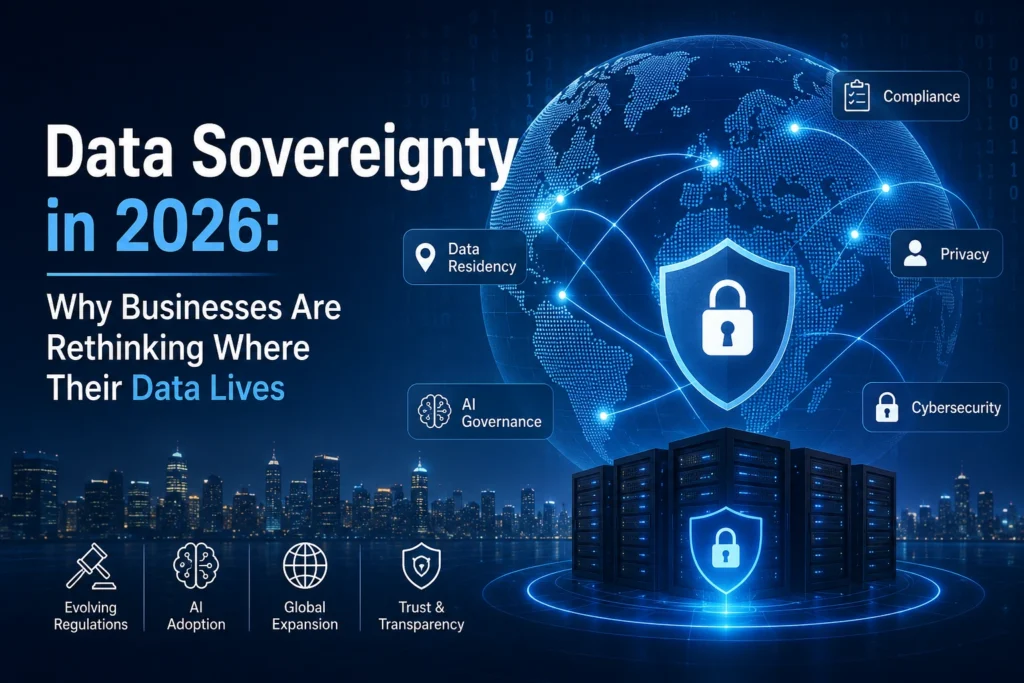
The Rise of Data Sovereignty: Why Businesses Must Know Where Their Data Lives
The Growing Impact of Regulations, AI, Cybersecurity, and Global Data Governance
For years, organizations focused primarily on collecting, storing, and analyzing data.
The assumption was simple: store data in the cloud, secure it properly, and use it to drive business decisions.
However, in 2026, a new question has become equally important:
Where exactly is that data stored, processed, and governed?
As businesses become increasingly global and data-driven, concerns about privacy, compliance, cybersecurity, and national regulations are reshaping how organizations manage information.
This shift has brought a relatively technical concept into the boardroom:
Data Sovereignty
Today, data sovereignty is no longer just an IT concern.
It is a strategic business issue affecting cloud strategy, AI adoption, compliance, customer trust, and international expansion.
What Is Data Sovereignty?
Data sovereignty refers to the principle that data is subject to the laws and regulations of the country where it is stored or processed.
For example:
- Customer information stored in one country may be governed by that country’s privacy laws.
- Healthcare records may need to remain within specific jurisdictions.
- Financial data may face restrictions regarding international transfers.
As organizations expand globally, managing these requirements becomes increasingly complex.
Why Data Sovereignty Is Becoming Critical
Several major trends are accelerating its importance.
The Explosion of AI
Modern AI systems require enormous amounts of data.
Organizations are increasingly asking:
- Where is training data stored?
- Who can access it?
- Which regulations apply?
As AI adoption grows, data governance becomes more important than ever.
Increasing Privacy Regulations
Governments worldwide continue introducing stricter requirements around:
- Personal information
- Healthcare data
- Financial records
- Consumer privacy
Businesses must ensure compliance across multiple jurisdictions simultaneously.
Cybersecurity Concerns
Data breaches are becoming more sophisticated and costly.
Organizations are looking for ways to improve control over sensitive information while reducing exposure to international risks.
The Difference Between Data Privacy, Data Residency, and Data Sovereignty
These concepts are often confused.
Data Privacy
Focuses on how information is collected, used, and protected.
Data Residency
Refers to the physical location where data is stored.
Data Sovereignty
Determines which country’s laws apply to that data.
Understanding these distinctions is becoming essential for modern businesses.
Why Enterprises Are Rethinking Cloud Strategies
The early cloud era prioritized flexibility and scalability.
Today, organizations must balance those benefits with regulatory obligations.
Many enterprises now evaluate cloud providers based on:
- Regional availability
- Compliance capabilities
- Data governance controls
- Jurisdictional requirements
This is influencing infrastructure decisions across industries.
Industry-Specific Challenges
Healthcare
Healthcare organizations manage highly sensitive patient information.
Requirements often include:
- Localized data storage
- Strict privacy controls
- Auditability
- Compliance reporting
Failure to meet these obligations can result in significant penalties.
Financial Services
Banks and financial institutions face extensive regulations regarding:
- Customer records
- Transaction histories
- Fraud monitoring data
Cross-border data transfers often require additional oversight.
Government and Public Sector
Government agencies increasingly require citizen information to remain within national borders.
This trend is driving investment in sovereign cloud environments.
SaaS Companies
Software providers serving international customers must manage data across multiple regulatory frameworks simultaneously.
This creates new architectural and operational challenges.
The Rise of Sovereign Cloud Solutions
One of the most important responses to data sovereignty concerns is the growth of sovereign cloud infrastructure.
Sovereign clouds are designed to provide:
- Local data storage
- Regional governance controls
- Compliance management
- Enhanced transparency
Major cloud providers are investing heavily in these capabilities to meet enterprise demand.
Data Sovereignty and Artificial Intelligence
AI is making data sovereignty even more complex.
Organizations must now consider:
AI Training Data
Where was the data collected?
Model Hosting
Where are AI models deployed?
Data Processing
Which jurisdictions govern AI-generated insights?
Regulatory Compliance
Can AI systems comply with regional requirements?
These questions are becoming central to enterprise AI strategies.
Business Benefits of Strong Data Sovereignty Strategies
Organizations that proactively address sovereignty concerns often gain advantages in:
Regulatory Compliance
Reduced risk of legal and regulatory issues.
Customer Trust
Consumers increasingly value transparency regarding data usage.
Risk Management
Improved control over sensitive information.
Global Expansion
Businesses can enter new markets more confidently.
Challenges Organizations Must Overcome
While data sovereignty is important, implementation can be complex.
Multi-Region Infrastructure
Managing data across multiple jurisdictions requires sophisticated architectures.
Operational Complexity
Different regulations often require different processes and controls.
Cost Considerations
Localized infrastructure and governance requirements can increase operational expenses.
However, many organizations view these investments as necessary for long-term growth.
The Future: Data as a Geopolitical Asset
Data is increasingly being viewed not only as a business asset but also as a strategic national resource.
Governments worldwide are introducing policies designed to:
- Protect citizen information
- Strengthen digital independence
- Improve cybersecurity
- Regulate AI systems
As a result, data sovereignty will likely become even more influential over the next decade.
How Our Company Helps Businesses Build Sovereignty-Ready Digital Architectures
At our company, we help organizations design secure, compliant, and scalable technology ecosystems that support modern data governance requirements.
Our expertise includes:
- Cloud architecture consulting
- Data governance strategies
- Compliance-focused development
- Enterprise modernization
- AI infrastructure planning
- Cybersecurity solutions
We help businesses prepare for an increasingly regulated and data-driven future.
Final Thoughts
Data sovereignty is rapidly becoming one of the most important considerations in modern digital strategy.
As organizations expand globally, adopt AI, and manage growing volumes of sensitive information, understanding where data lives and which laws govern it has become a business necessity.
The companies that proactively address data sovereignty today will be better positioned to:
- Build trust
- Reduce risk
- Accelerate innovation
- Expand globally
In 2026, managing data is no longer enough.
Successful organizations must also understand who governs that data and where it belongs.