
Composable Business: Why Modular Enterprises Will Outperform Traditional Organizations in 2026
How API-First Architecture, Modular Applications, and Business Agility Are Redefining Enterprise Success
Imagine trying to renovate a house where every wall, pipe, and electrical wire is permanently connected. Changing one room would require rebuilding half the house.
For decades, many businesses have operated in much the same way. Their technology ecosystems were built as large, tightly integrated systems where every department depended on the others. While these systems worked well in stable environments, they struggle to keep pace with today’s rapidly changing business landscape.
Markets shift overnight. Customer expectations evolve continuously. New regulations emerge with little warning. Artificial intelligence is transforming industries at unprecedented speed.
In this environment, businesses can no longer afford technology that takes months or even years to adapt.
Instead, organizations are embracing a new operating model known as the Composable Business.
Rather than relying on large, rigid systems, composable enterprises build their operations from independent, reusable components that can be assembled, replaced, and expanded as business needs change.
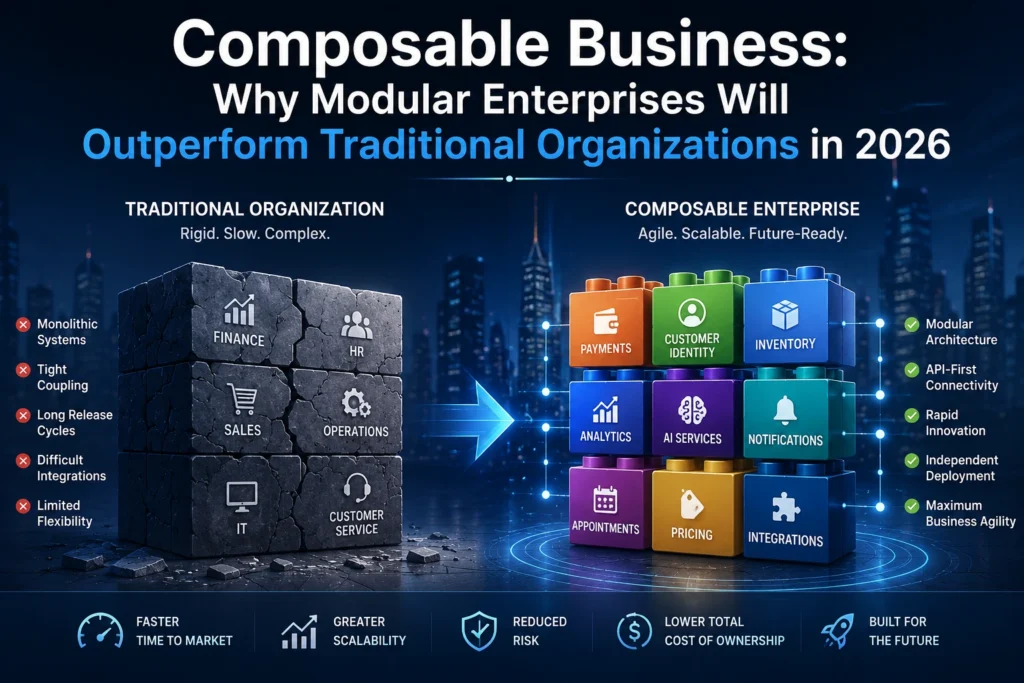
Much like building with LEGO® bricks, organizations gain the flexibility to create new capabilities without rebuilding everything from scratch.
This modular approach is becoming a defining characteristic of high-performing enterprises in 2026.
What Is a Composable Business?
A composable business is an organization that designs its processes, technology, and services as modular building blocks.
Instead of creating one large application responsible for every function, businesses develop smaller, independent capabilities that work together through APIs and standardized integrations.
Each component performs a specific role while remaining loosely connected to the rest of the ecosystem.
Examples include:
- Customer identity services
- Payment processing
- Inventory management
- Appointment scheduling
- Analytics engines
- AI recommendation services
- Notification systems
These components can be reused across multiple products, departments, and business units.
This creates a technology environment that evolves continuously rather than requiring complete system replacements.
Why Businesses Are Moving Toward Composable Architecture
Digital transformation is accelerating across every industry.
Organizations must launch products faster, respond to market changes quickly, and integrate emerging technologies without disrupting existing operations.
Traditional enterprise systems often make these goals difficult to achieve.
Composable architecture addresses these challenges by enabling continuous innovation.
Several trends are driving this shift.
Increasing Market Volatility
Customer expectations change rapidly.
Businesses must frequently introduce:
- New digital services
- Customer experiences
- Pricing models
- Sales channels
- AI-powered capabilities
Rigid technology systems slow these initiatives.
Composable systems allow organizations to adapt much faster.
The Rise of API-First Development
Modern enterprises increasingly treat APIs as strategic business assets rather than technical integration tools.
An API-first approach ensures every business capability can communicate with other systems securely and efficiently.
This enables organizations to combine existing capabilities in new ways without rewriting core applications.
For example, a healthcare provider can connect patient scheduling, billing, telemedicine, and AI-assisted diagnostics through standardized APIs rather than building entirely new platforms.
Cloud-Native Technologies Have Matured
Cloud computing has evolved beyond infrastructure.
Today’s cloud-native applications use:
- Containers
- Microservices
- Serverless computing
- Event-driven architectures
- Managed APIs
These technologies naturally support modular business design.
Organizations can scale individual services independently while maintaining overall system performance.
From Monolithic Enterprises to Modular Organizations
Traditional enterprises often rely on monolithic applications.
These systems contain multiple business functions within a single codebase.
Although manageable during initial development, they become increasingly difficult to maintain as organizations grow.
A composable enterprise separates these functions into independent services.
| Traditional Enterprise | Composable Enterprise |
|---|---|
| Large monolithic systems | Modular business capabilities |
| Long development cycles | Rapid iteration |
| Difficult integrations | API-driven connectivity |
| Organization-wide deployments | Independent service updates |
| Limited flexibility | Continuous adaptability |
The result is a business capable of evolving without disrupting day-to-day operations.
Core Principles of a Composable Business
Modular Software Architecture
Applications are built as independent services rather than tightly connected systems.
Each module performs one responsibility exceptionally well.
Examples include:
- Authentication
- Inventory
- Customer profiles
- Reporting
- Notifications
This simplifies maintenance and accelerates development.
API-First Business Strategy
APIs become the foundation of collaboration across applications.
Instead of hard-coded integrations, standardized interfaces enable seamless communication between systems.
This approach also simplifies partnerships with external vendors and third-party platforms.
Reusable Business Capabilities
Rather than building identical functionality multiple times, organizations create reusable services.
For example, a single payment module can support:
- E-commerce websites
- Mobile applications
- Customer portals
- Internal business systems
Reuse reduces development costs while improving consistency.
Continuous Innovation
Because modules operate independently, businesses can introduce new capabilities without affecting unrelated systems.
This dramatically reduces deployment risk.
Business Benefits of Composable Enterprises
Faster Product Launches
New digital products can reuse existing business capabilities instead of starting from scratch.
Development timelines shrink significantly.
Improved Business Agility
Organizations respond more effectively to:
- Regulatory changes
- Customer expectations
- Market disruptions
- New technologies
Instead of rebuilding entire systems, teams modify only the affected components.
Enterprise Scalability
As demand grows, businesses can scale individual services independently.
A sudden increase in online transactions does not require scaling unrelated business functions.
This improves both performance and infrastructure efficiency.
Lower Long-Term Costs
Although modular architecture requires thoughtful planning, reusable components reduce duplicated development efforts.
Maintenance also becomes more manageable because individual modules can evolve independently.
Real-World Applications Across Industries
Healthcare
Healthcare providers are creating modular ecosystems that connect:
- Electronic medical records
- Telemedicine platforms
- Patient portals
- Pharmacy services
- Insurance verification
Each capability operates independently while contributing to a unified patient experience.
Financial Services
Banks increasingly compose digital experiences by combining:
- Identity verification
- Fraud detection
- Payment processing
- Credit scoring
- Customer onboarding
This enables faster rollout of new financial products.
Retail
Retailers use composable commerce platforms to connect:
- Product catalogs
- Inventory systems
- Pricing engines
- Recommendation services
- Loyalty programs
Each capability can evolve without disrupting the shopping experience.
SaaS Companies
Software providers frequently develop modular platforms where customers activate only the capabilities they require.
This improves flexibility while supporting diverse customer needs.
Challenges of Becoming a Composable Business
While the benefits are significant, organizations must approach composability strategically.
Governance
As the number of services grows, businesses require strong governance over:
- APIs
- Security
- Documentation
- Version management
Without proper oversight, complexity can increase.
Organizational Change
Composable business is not only a technology initiative.
Teams must also embrace collaborative development, cross-functional ownership, and agile delivery models.
Security
Each API and service becomes part of the organization’s digital perimeter.
Robust authentication, authorization, and monitoring are essential.
Emerging Technologies Accelerating Composable Business
Several innovations are making composable enterprises even more powerful.
- Artificial Intelligence enables intelligent orchestration between services.
- Low-code platforms allow rapid assembly of new workflows.
- Event-driven architectures enable real-time responsiveness.
- Edge computing supports localized decision-making.
- Intelligent automation reduces manual coordination across business functions.
Together, these technologies enable organizations to innovate continuously.
How Our Company Helps Organizations Build Composable Enterprises
At [Your Company Name], we help businesses modernize legacy systems and build modular digital ecosystems that support long-term growth.
Our services include:
- API-first application development
- Custom enterprise software
- Cloud-native architecture
- Microservices implementation
- Enterprise system integration
- Digital transformation consulting
- AI-powered business solutions
We design technology platforms that are flexible, scalable, and ready for future innovation.
Final Thoughts
The pace of business is no longer measured in years. It is measured in weeks, days, and sometimes hours.
Organizations built on rigid technology foundations struggle to respond quickly to changing market demands.
Composable businesses take a different approach.
By creating modular capabilities connected through APIs, they gain the flexibility to innovate continuously, launch products faster, and adapt to new opportunities with confidence.
In the coming years, the companies that lead their industries will not necessarily be those with the largest technology budgets.
They will be the organizations with the most adaptable technology foundations.
A composable business isn’t simply about modular software. It’s about building an enterprise that is designed to evolve.