
Why Every Business Will Need an AI Operating System (AI OS)
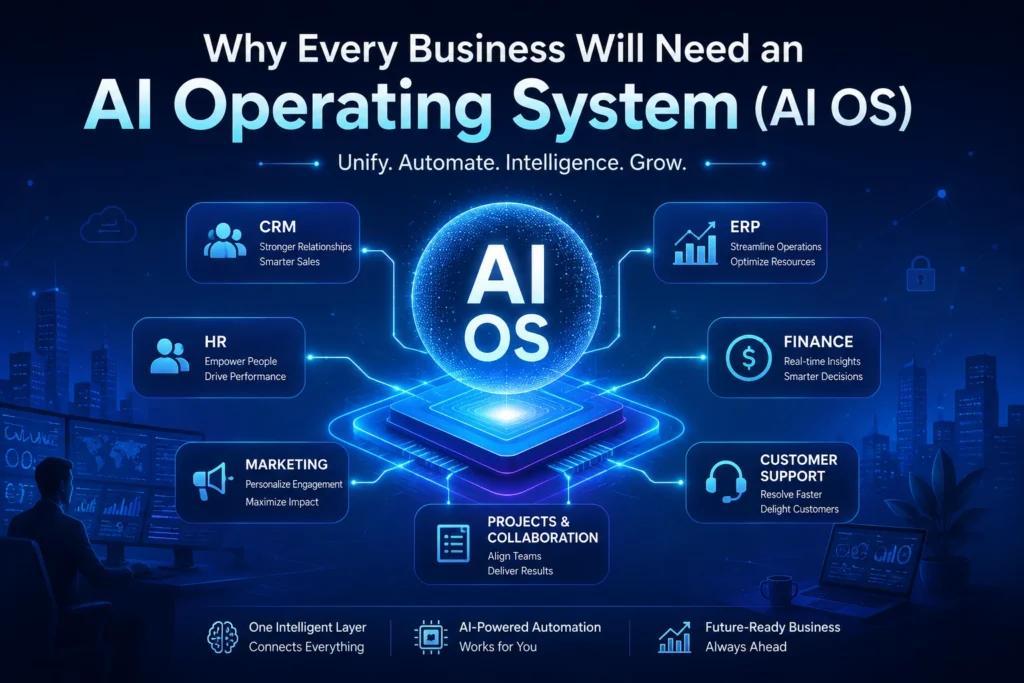
The Next Evolution of Enterprise Technology
For decades, businesses have invested heavily in enterprise software such as CRM,
ERP, HRMS, finance systems, marketing automation platforms, and customer support
solutions. While each application solves a specific business problem, most still
operate independently, creating data silos across organizations.
As Artificial Intelligence becomes more advanced, disconnected systems prevent AI
from making intelligent business decisions. This is why AI Operating Systems (AI OS)
are emerging as the next evolution of enterprise technology.
What Is an AI Operating System?
An AI Operating System is an intelligent software layer that sits on top of existing
enterprise applications and connects them into a unified ecosystem.
Instead of replacing existing software, AI OS integrates with:
- CRM
- ERP
- HRMS
- Finance Software
- Customer Support Platforms
- Marketing Automation Tools
- Project Management Systems
- Business Intelligence Platforms
- Collaboration Tools
- Document Management Systems
Why Traditional Enterprise Software Is No Longer Enough
Modern organizations use dozens of software applications. Each system stores valuable
information, but very few share complete business context.
For example, customer information may exist in:
- CRM for sales
- ERP for inventory
- Finance for invoices
- Support platforms for tickets
- Marketing tools for campaigns
Employees spend valuable time switching between systems. AI OS removes this
fragmentation by connecting all business data.
Why AI Operating Systems Are Emerging
1. Enterprise AI is Mature
- Understand business language
- Analyze enterprise data
- Automate workflows
- Generate recommendations
- Coordinate complex tasks
2. API-Driven Architecture
Modern software exposes APIs, making it possible for AI OS to integrate with
existing business applications without replacing them.
3. Growing Software Complexity
Organizations continue adopting specialized software. AI OS simplifies complexity
by creating one intelligent interaction layer.
How an AI Operating System Works
- Data Integration
- Business Context Understanding
- Intelligent Decision Support
- Workflow Automation
Business Benefits
- Unified business visibility
- Faster decision making
- Higher employee productivity
- Better customer experience
- Improved scalability
AI OS vs Traditional Software
| Traditional Software | AI Operating System |
|---|---|
| Separate applications | Unified intelligent ecosystem |
| Department-specific data | Enterprise-wide context |
| Manual coordination | AI-orchestrated workflows |
| Static dashboards | Real-time recommendations |
| Reactive operations | Predictive operations |
Industry Applications
Healthcare
Connect patient records, scheduling, billing, and diagnostics into one intelligent environment.
Financial Services
Integrate fraud detection, lending, compliance, and customer service.
Manufacturing
Coordinate production planning, inventory, procurement, and maintenance.
Retail & E-commerce
Integrate customer behavior, pricing, inventory, fulfillment, and marketing.
Challenges
- Data Quality
- Security & Access Control
- Organizational Change
The Future
AI Operating Systems will become the digital brain of modern enterprises,
connecting people, processes, applications, and data into one intelligent ecosystem.
How Our Company Helps
- AI Strategy & Consulting
- Enterprise AI Platform Development
- CRM & ERP Development
- API Integration
- Workflow Automation
- Cloud Solutions
- AI Copilots
- Data Engineering
Final Thoughts
The future of enterprise technology is not about adding more software.
It is about making existing software work together intelligently.
AI Operating Systems will help organizations become truly intelligent enterprises.