
AI Governance in 2026: Building Responsible AI That Businesses Can Trust
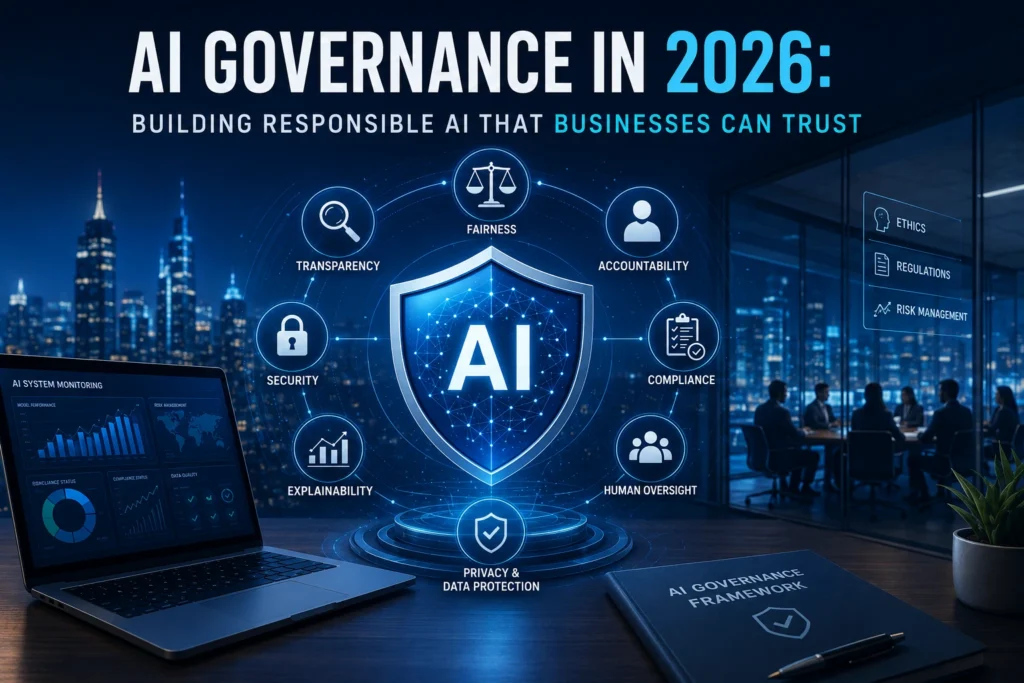
Why Responsible AI Has Become a Business Imperative Rather Than Just a Technology Initiative
Artificial Intelligence has evolved from an emerging technology into a critical business capability.
Organizations are using AI to automate operations, personalize customer experiences, improve healthcare outcomes, detect financial fraud, optimize supply chains, and support strategic decision-making.
The opportunities are enormous.
However, as AI becomes more deeply integrated into business operations, a new challenge has emerged.
Can businesses trust the decisions AI makes?
What happens if an AI model makes a biased hiring recommendation?
What if an AI-powered healthcare system provides an incorrect diagnosis?
How can a financial institution explain why an AI system rejected a loan application?
Who is responsible when an AI system makes a mistake?
These questions are moving beyond IT departments and into boardrooms, regulatory agencies, and executive strategy discussions.
In 2026, successful AI adoption is no longer measured solely by model accuracy or automation capabilities.
It is increasingly measured by transparency, accountability, fairness, security, and compliance.
This is why AI Governance has become one of the most important priorities for enterprise organizations.
What Is AI Governance?
AI Governance is the framework of policies, processes, technologies, and oversight mechanisms that ensure AI systems are developed, deployed, and managed responsibly.
Its purpose is not to slow innovation.
Instead, it ensures AI remains:
- Fair
- Transparent
- Secure
- Explainable
- Reliable
- Compliant with regulations
- Aligned with business objectives
AI governance creates trust between organizations, employees, customers, regulators, and technology.
Without governance, even highly advanced AI systems can create significant business, legal, and reputational risks.
Why AI Governance Is Becoming Critical in 2026
The rapid adoption of AI has introduced new challenges that traditional IT governance frameworks were never designed to address.
Organizations are now relying on AI to make decisions that directly affect customers, employees, and business operations.
Examples include:
- Medical treatment recommendations
- Insurance claim approvals
- Credit risk assessments
- Recruitment decisions
- Fraud detection
- Customer service automation
- Supply chain forecasting
As AI influences more critical decisions, organizations must ensure those decisions are trustworthy.
The Growing Risks of Uncontrolled AI
Bias and Discrimination
AI models learn from historical data.
If that data contains bias, AI may unintentionally reinforce unfair outcomes.
Examples include:
- Hiring bias
- Lending discrimination
- Healthcare inequalities
- Insurance pricing inconsistencies
Responsible governance helps identify and reduce these risks before deployment.
Lack of Transparency
Many advanced AI models function as “black boxes.”
They generate decisions without clearly explaining how those decisions were made.
For businesses operating in regulated industries, this lack of transparency creates serious challenges.
Customers, auditors, and regulators increasingly expect organizations to explain AI-generated outcomes.
Regulatory Compliance
Governments around the world are introducing regulations governing AI development and usage.
Organizations must demonstrate:
- Responsible AI practices
- Data protection
- Human oversight
- Risk assessments
- Documentation
- Accountability
Compliance is becoming a competitive requirement rather than simply a legal obligation.
Core Pillars of AI Governance
Effective AI governance is built upon several foundational principles.
AI Ethics
Ethical AI ensures technology aligns with human values.
Organizations should evaluate AI systems against principles such as:
- Fairness
- Non-discrimination
- Accountability
- Privacy
- Human well-being
- Social responsibility
Ethics should be incorporated throughout the AI lifecycle rather than added after deployment.
Explainable AI (XAI)
One of the biggest challenges with modern AI systems is understanding how they reach conclusions.
Explainable AI addresses this problem by making AI decisions understandable to humans.
For example:
Instead of simply rejecting a loan application, an explainable AI system can identify the specific factors that influenced the decision.
Benefits include:
- Greater customer trust
- Easier regulatory compliance
- Improved model debugging
- Better business decision-making
Transparency increases confidence in AI systems.
AI Audits
Just as financial systems undergo audits, AI models increasingly require independent evaluation.
AI audits assess:
- Data quality
- Model performance
- Bias detection
- Security controls
- Regulatory compliance
- Documentation quality
Regular audits help organizations identify weaknesses before they affect customers or operations.
AI Compliance
AI compliance ensures organizational practices align with applicable regulations and industry standards.
Compliance activities often include:
- Data governance
- Privacy controls
- Consent management
- Model documentation
- Human oversight
- Security assessments
As AI regulations continue evolving globally, compliance programs must remain adaptable.
Model Monitoring
AI models are not static.
Their performance can change over time due to new data, evolving customer behavior, or changing business environments.
Continuous monitoring helps organizations detect:
- Performance degradation
- Prediction errors
- Data drift
- Model drift
- Unexpected behavior
Monitoring enables organizations to maintain AI quality long after deployment.
AI Risk Management
AI introduces risks that extend beyond cybersecurity.
Organizations should evaluate:
- Operational risks
- Ethical risks
- Legal risks
- Reputational risks
- Security risks
- Financial risks
A structured risk management strategy ensures AI supports business goals without creating unnecessary exposure.
AI Governance Across Industries
Healthcare
Healthcare organizations use AI for:
- Medical imaging
- Clinical decision support
- Patient triage
- Predictive analytics
Governance helps ensure:
- Clinical accuracy
- Patient safety
- Regulatory compliance
- Explainable recommendations
Financial Services
Banks rely on AI for:
- Fraud detection
- Credit scoring
- Risk management
- Investment analysis
Governance helps reduce bias while improving transparency and regulatory readiness.
Retail and E-commerce
Retailers use AI to personalize shopping experiences.
Governance ensures personalization remains fair, transparent, and privacy-conscious.
Manufacturing
Manufacturers deploy AI for predictive maintenance, quality inspection, and supply chain optimization.
Governance improves operational reliability while reducing business risk.
Business Benefits of Strong AI Governance
Organizations investing in governance gain significant advantages.
- Increased Customer Trust: Transparent AI encourages greater confidence in digital services.
- Better Decision Quality: Well-governed AI produces more reliable and consistent outcomes.
- Reduced Regulatory Risk: Compliance programs minimize legal and financial exposure.
- Improved AI Performance: Continuous monitoring identifies opportunities for optimization.
- Faster Enterprise Adoption: Business leaders are more willing to expand AI initiatives when governance frameworks are already established.
Common Mistakes Organizations Make
Many businesses focus heavily on building AI models while overlooking governance.
Common mistakes include:
- Deploying models without documentation
- Ignoring bias testing
- Failing to monitor production models
- Lack of human oversight
- Poor data governance
- Inconsistent compliance processes
These issues can undermine otherwise successful AI initiatives.
Best Practices for Building Responsible AI
Establish AI Governance Committees
Cross-functional teams should oversee AI strategy, ethics, compliance, and risk management.
Build Explainability Into Every AI Project
Transparency should be considered during design, not after deployment.
Continuously Monitor AI Systems
Governance does not end when a model goes live.
Performance should be evaluated throughout the model’s lifecycle.
Create Clear Accountability
Every AI system should have designated business and technical owners responsible for governance and oversight.
Invest in Responsible Data Management
High-quality, diverse, and well-governed data remains the foundation of trustworthy AI.
The Future of AI Governance
Over the next decade, AI governance will become as essential as cybersecurity and data governance.
Organizations will increasingly implement:
- Automated governance platforms
- Real-time compliance monitoring
- AI lifecycle management
- Continuous risk assessment
- Ethical AI scorecards
- Human-AI collaboration frameworks
The businesses that build governance into their AI strategy from the beginning will innovate faster because they will have the confidence to deploy AI at scale.
How Our Company Helps Businesses Build Responsible AI
At [Your Company Name], we help organizations develop AI solutions that are not only intelligent but also transparent, secure, and compliant.
Our expertise includes:
- AI strategy and consulting
- Responsible AI implementation
- Explainable AI (XAI) integration
- AI governance frameworks
- Model monitoring and lifecycle management
- AI risk assessment
- Data governance and compliance
- Enterprise AI platform development
We believe successful AI is not measured solely by how powerful it is, but by how trustworthy it is.
Final Thoughts
Artificial Intelligence is transforming every industry, but trust will determine how far that transformation goes.
Organizations that focus only on model performance risk overlooking the ethical, legal, and operational challenges that come with AI adoption.
AI Governance provides the foundation for responsible innovation by ensuring AI systems are transparent, explainable, secure, and accountable throughout their lifecycle.
In 2026, businesses are no longer asking:
“Can we implement AI?”
They are asking:
“Can we trust the AI we deploy?”
The organizations that answer that question with confidence will be the ones that lead the next generation of digital transformation.