
Enterprise Memory: Why Companies Are Building AI That Never Forgets
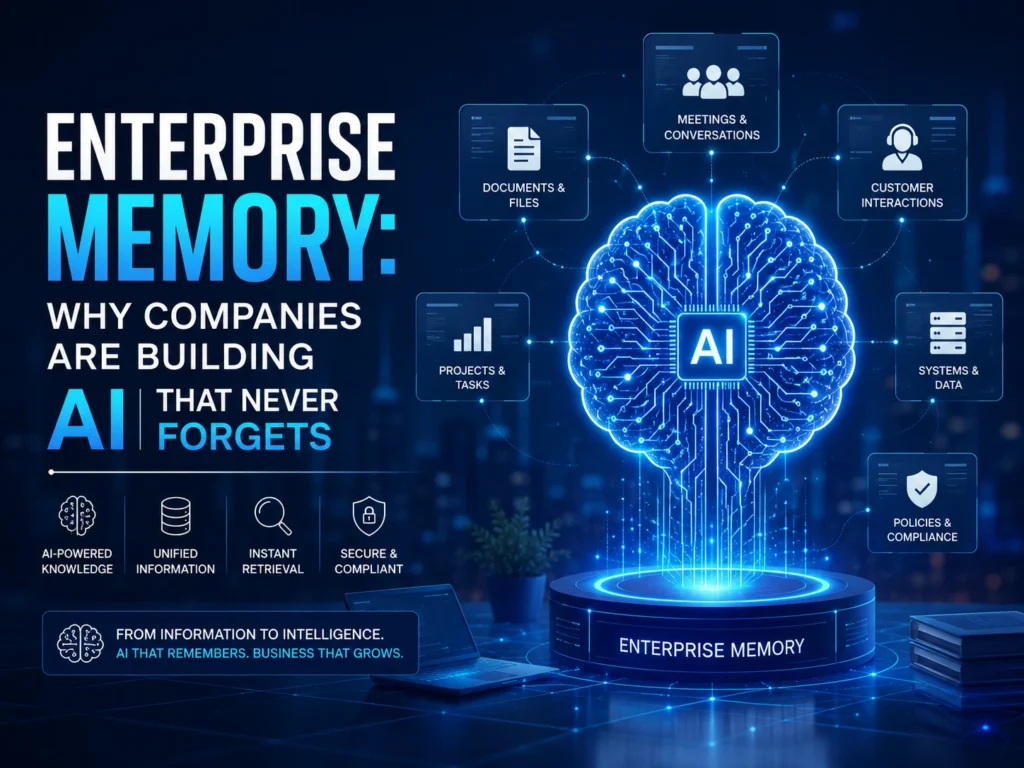
How AI-Powered Knowledge Systems Are Transforming Business Intelligence, Decision-Making, and Organizational Productivity
Every organization generates knowledge.
Every customer meeting, project, proposal, support ticket, policy update, product launch, and strategic decision creates valuable information that could help the business make better decisions in the future.
Yet, despite investing millions in digital transformation, many organizations still struggle with a surprisingly common problem:
They know the information exists—but they can’t find it when they need it.
Employees spend valuable time searching through emails, shared drives, chat conversations, CRM systems, project management tools, and internal documentation just to answer simple questions.
- “Has anyone solved this problem before?”
- “Which client requested this feature?”
- “What was the decision made during last year’s strategy meeting?”
- “Where is the latest compliance document?”
- “Who worked on a similar project?”
In many cases, the answer exists—but it’s buried inside disconnected systems.
As artificial intelligence becomes more advanced, businesses are moving beyond traditional document management and enterprise search toward a new concept:
Enterprise Memory
Rather than simply storing information, enterprise memory enables AI to understand, connect, retain, and retrieve organizational knowledge instantly.
Instead of employees searching for information, AI remembers it.
For modern businesses, this is becoming one of the most valuable competitive advantages.
What Is Enterprise Memory?
Enterprise Memory is an AI-powered knowledge layer that continuously captures, organizes, and recalls information generated across an organization.
Unlike traditional knowledge bases that depend on manually written documents, enterprise memory builds relationships between data, people, projects, conversations, and business processes.
It allows AI to answer questions such as:
- Which customers reported similar issues last quarter?
- What solutions worked in previous implementations?
- Which departments approved this policy?
- What commitments were made during the last client meeting?
- Which experts inside the company have worked on similar projects?
Instead of retrieving isolated documents, AI provides meaningful business context.
Why Traditional Knowledge Management Is No Longer Enough
For years, organizations relied on document repositories and internal portals.
While these systems helped store information, they often failed to make knowledge easily accessible.
Employees still needed to know:
- Where the information was stored
- Which document contained the answer
- Which version was current
- Who created it
As organizations grow, this approach becomes increasingly inefficient.
Knowledge becomes fragmented across:
- Email platforms
- CRM systems
- ERP software
- Cloud storage
- Project management tools
- Collaboration platforms
- Customer support systems
Finding the right information often requires searching multiple applications.
Enterprise memory eliminates this fragmentation by creating a unified knowledge layer across the business.
Why Enterprise Memory Is Trending in 2026
The Explosion of Business Data
Modern organizations generate enormous volumes of information every day.
This includes:
- Customer conversations
- Product documentation
- Meeting transcripts
- Contracts
- Support interactions
- Operational reports
- AI-generated content
Without intelligent organization, much of this information remains unused.
Enterprise memory transforms raw data into accessible organizational knowledge.
AI Has Become Context-Aware
Earlier search systems relied primarily on keywords.
Today’s AI understands intent, relationships, and business context.
Employees can ask questions naturally, such as:
“Which healthcare projects involved predictive analytics and achieved the highest client satisfaction?”
Instead of returning hundreds of documents, AI delivers a concise, contextual answer supported by relevant evidence.
Knowledge Loss Is Increasing
Organizations experience constant workforce changes.
When experienced employees leave, they often take years of institutional knowledge with them.
Enterprise memory helps preserve:
- Project experience
- Technical expertise
- Business decisions
- Customer history
- Operational best practices
This reduces dependency on individual employees.
How Enterprise Memory Works
Data Collection
Information is continuously gathered from business systems including:
- CRM platforms
- ERP applications
- Project management tools
- Email systems
- Knowledge bases
- Collaboration platforms
- Customer support software
Knowledge Understanding
AI analyzes relationships between:
- People
- Projects
- Customers
- Documents
- Processes
- Decisions
Rather than treating every file independently, it understands how information connects across the organization.
Contextual Retrieval
Instead of keyword matching, AI retrieves knowledge based on meaning and business context.
Employees receive precise answers rather than long lists of search results.
Continuous Learning
As the organization evolves, enterprise memory continuously updates itself.
Every completed project, new policy, customer interaction, and business decision strengthens the organization’s collective intelligence.
Real-World Business Applications
Healthcare
Healthcare organizations manage vast amounts of clinical, operational, and administrative knowledge.
Enterprise memory can help clinicians and administrators quickly access:
- Treatment protocols
- Previous patient care workflows
- Compliance guidelines
- Research findings
- Operational procedures
This improves decision-making while reducing administrative effort.
Customer Support
Support teams frequently encounter recurring issues.
Enterprise memory enables AI to instantly identify:
- Previous resolutions
- Similar customer cases
- Product documentation
- Known workarounds
This shortens resolution times and improves customer satisfaction.
Sales and Business Development
Sales professionals often spend valuable time searching for:
- Past proposals
- Client meeting notes
- Pricing discussions
- Contract history
Enterprise memory provides immediate access to this information, helping teams prepare for customer interactions more effectively.
Software Development
Development teams benefit from rapid access to:
- Architecture decisions
- Code documentation
- Technical discussions
- Previous implementation approaches
- Known issues
This reduces duplicated effort and accelerates product development.
Business Benefits of Enterprise Memory
Organizations implementing enterprise memory often experience significant improvements.
- Faster Decision-Making: Employees spend less time searching and more time acting on reliable information.
- Increased Productivity: Knowledge workers can focus on solving problems rather than locating documents.
- Better Customer Experiences: Teams gain instant access to historical customer interactions, enabling more personalized service.
- Stronger Collaboration: Departments share knowledge more effectively because information becomes organization-wide rather than team-specific.
- Preservation of Institutional Knowledge: Critical expertise remains available even when employees change roles or leave the organization.
Enterprise Search vs Enterprise Memory
| Traditional Enterprise Search | Enterprise Memory |
|---|---|
| Searches documents | Understands business knowledge |
| Keyword-based | Context-aware AI |
| Returns file lists | Provides direct answers |
| Static information | Continuously updated |
| Depends on user searching | AI proactively connects information |
The shift is similar to the difference between a digital filing cabinet and an experienced colleague who remembers every important detail.
Challenges Organizations Must Address
Data Quality
AI can only generate reliable insights from accurate and well-governed information.
Organizations should establish strong data management practices before expanding enterprise memory initiatives.
Access Control
Not every employee should have access to every piece of organizational knowledge.
Role-based permissions and security policies remain essential.
Privacy and Compliance
Organizations handling sensitive information must ensure enterprise memory systems comply with industry regulations and internal governance standards.
This is particularly important in sectors such as healthcare, finance, and government.
The Future: AI as the Organization’s Collective Memory
The next generation of enterprise AI will move beyond answering questions.
It will proactively remind teams about:
- Previous commitments
- Project risks
- Customer preferences
- Regulatory changes
- Similar business situations
- Lessons learned from earlier initiatives
Instead of functioning as a search engine, AI will become an organizational advisor that continuously learns from every interaction.
The companies that capture and reuse knowledge effectively will innovate faster, reduce costly mistakes, and make better decisions.
How Our Company Helps Organizations Build Enterprise Memory Solutions
At [Your Company Name], we help businesses transform scattered information into intelligent, searchable organizational knowledge.
Our expertise includes:
- AI-powered knowledge management platforms
- Enterprise AI assistant development
- Intelligent document processing
- Custom enterprise software development
- API and system integration
- Cloud-native data architecture
- AI search and semantic retrieval solutions
- Secure enterprise data governance
We build solutions that ensure your organization’s knowledge is never lost—and is always available when it matters most.
Final Thoughts
In the digital economy, information alone is no longer a competitive advantage.
The real advantage comes from how quickly an organization can access, understand, and apply its collective knowledge.
Enterprise Memory represents the next evolution of knowledge management. It transforms scattered documents into connected intelligence, allowing AI to remember projects, customer relationships, business decisions, and organizational expertise across every department.
As businesses continue to adopt AI, the question will no longer be:
“Where is the information stored?”
Instead, it will be:
“How quickly can our organization turn knowledge into action?”
The companies that build an enterprise memory today will be the ones making faster, smarter, and more confident decisions tomorrow.