
The Death of Software as We Know it: Why Outcome-as-a-Service Is the Next Big Business Model
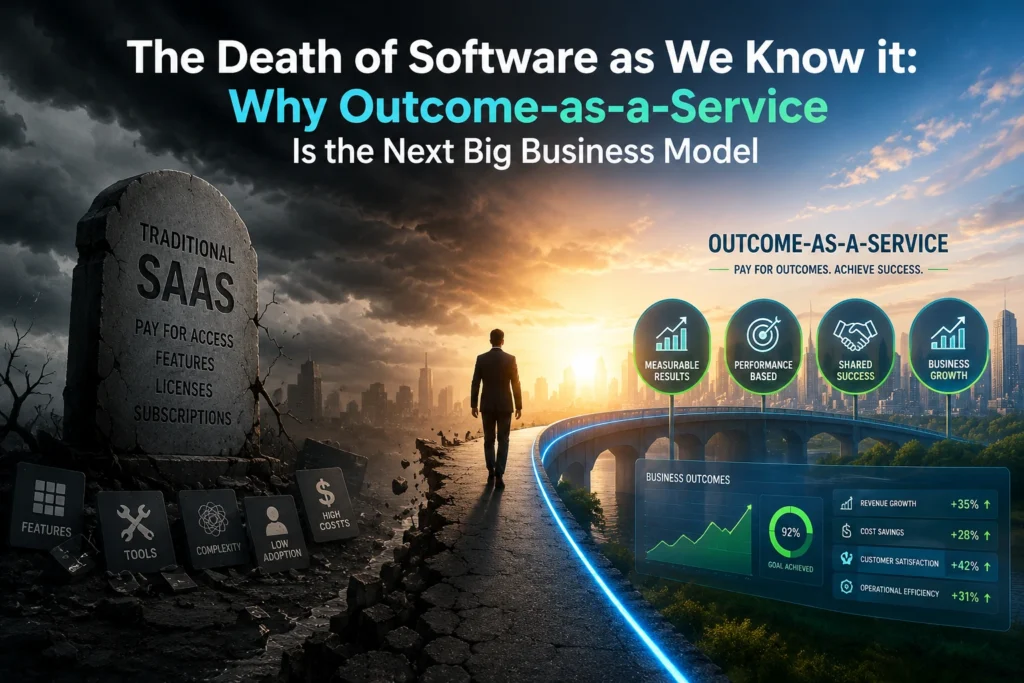
The Death of Software as We Know It: Why Outcome-as-a-Service Is the Next Big Business Model
How Businesses Are Moving Beyond SaaS to Pay for Results Instead of Tools
For the last two decades, Software-as-a-Service (SaaS) transformed the technology industry.
Instead of purchasing expensive software licenses, businesses subscribed to cloud-based platforms and paid monthly or annual fees.
This model created a multi-billion-dollar software economy and changed how organizations adopted technology.
However, a new shift is emerging in 2026.
Businesses are increasingly asking:
Why should we pay for software if what we really want is the outcome?
This question is driving the rise of a new business model:
Outcome-as-a-Service (OaaS)
Instead of paying for access to tools, companies are beginning to pay for measurable business results.
This evolution could fundamentally reshape how technology is developed, sold, and consumed over the next decade.
What Is Outcome-as-a-Service?
Outcome-as-a-Service is a business model where customers pay for specific business outcomes rather than software usage.
Traditional SaaS focuses on:
- User licenses
- Feature access
- Platform subscriptions
Outcome-as-a-Service focuses on:
- Leads generated
- Claims processed
- Support tickets resolved
- Sales conversions achieved
- Operational efficiencies delivered
The emphasis shifts from technology ownership to business value creation.
Why Businesses Are Moving Beyond SaaS
The SaaS market is more competitive than ever.
Organizations often subscribe to dozens or even hundreds of software platforms.
Common challenges include:
- Low adoption rates
- Feature overload
- Subscription fatigue
- Rising software costs
- Unclear ROI
Executives increasingly care less about software features and more about measurable business impact.
As a result, vendors are under pressure to demonstrate outcomes rather than functionality.
The Role of AI in Outcome-as-a-Service
Artificial intelligence is one of the primary reasons this model is becoming possible.
Modern AI systems can:
- Analyze business objectives
- Execute workflows
- Automate decisions
- Optimize performance
- Measure results
Instead of providing tools for employees, AI-powered systems can increasingly deliver outcomes directly.
For example:
- A marketing platform may no longer simply provide campaign management tools. Instead, it may guarantee a specific number of qualified leads.
- A customer service platform may charge based on successful issue resolution rather than seat licenses.
How Outcome-as-a-Service Differs from SaaS
| SaaS Model | Outcome-as-a-Service |
|---|---|
| Pay for software access | Pay for business outcomes |
| Focus on features | Focus on results |
| User-based pricing | Performance-based pricing |
| Customer manages execution | Provider manages execution |
| ROI varies by customer | ROI becomes central to pricing |
Industries Leading the Transition
Healthcare
- Reduced patient wait times
- Improved treatment adherence
- Better operational efficiency
Sales and Marketing
- Qualified leads
- Customer acquisition
- Revenue growth
Customer Service
- Resolution rates
- Customer satisfaction scores
- Support efficiency
Manufacturing
- Equipment uptime
- Production efficiency
- Predictive maintenance outcomes
Why Enterprises Prefer Outcome-Based Models
Better ROI Visibility
Executives can directly connect spending to measurable business value.
Reduced Technology Complexity
Organizations focus on objectives rather than managing multiple software platforms.
Shared Risk
Providers have incentives to ensure customers achieve success, creating stronger alignment between vendor and client goals.
Faster Business Impact
Outcome-focused solutions often prioritize execution over feature expansion.
The Technology Enablers Behind OaaS
- Artificial Intelligence – Enables intelligent decision-making and workflow execution.
- Automation Platforms – Reduce human intervention in repetitive processes.
- Real-Time Analytics – Provide continuous performance monitoring.
- Cloud Infrastructure – Supports scalable service delivery.
- API Ecosystems – Allow systems to connect and execute cross-platform workflows seamlessly.
Together, these technologies create environments where outcomes can be delivered more predictably.
Challenges Businesses Must Consider
Defining Success Metrics
- Measurement standards
- Performance indicators
- Accountability models
Data Transparency
Providers often require deep operational visibility to deliver outcomes effectively. Organizations must establish trust and governance frameworks.
Pricing Complexity
Outcome-based pricing models can be more difficult to structure than traditional subscriptions.
The Future: From Software Companies to Outcome Companies
The most successful technology providers of the next decade may not be those with the most features.
Instead, they may be the organizations that consistently deliver measurable business results.
Instead of saying:
“We sell software.”
Future providers may say:
- “We increase revenue.”
- “We reduce operational costs.”
- “We improve customer retention.”
The technology becomes invisible while the outcome becomes the product.
How Our Company Helps Businesses Build Outcome-Focused Digital Solutions
At our company, we help organizations move beyond traditional software delivery and create solutions aligned with measurable business objectives.
- AI-powered platforms
- Intelligent automation
- Cloud-native development
- Enterprise integrations
- Analytics-driven optimization
- Digital transformation consulting
We focus on building technology that delivers real business outcomes, not just software functionality.
Final Thoughts
The rise of Outcome-as-a-Service signals a major evolution in how businesses consume technology.
Organizations are becoming less interested in software ownership and more interested in measurable results.
As AI and automation continue advancing, this trend is likely to reshape:
- SaaS platforms
- Enterprise software
- Customer expectations
- Technology business models
In the coming years, the question will no longer be:
“Which software should we buy?”
Instead, it will be:
“Which partner can deliver the outcome we need?”