
The Rise of Industry Clouds: Why One-Size-Fits-All Cloud Platforms Are No Longer Enough
How Industry-Specific Cloud Solutions Are Accelerating Digital Transformation
Cloud computing transformed business operations over the past decade. Organizations moved away from on-premise infrastructure to gain scalability, flexibility, and cost efficiency.
However, as industries become more digital, businesses are discovering a new challenge: generic cloud platforms often fail to address industry-specific requirements.
A healthcare provider faces regulatory requirements very different from a financial institution. A manufacturing company has operational needs that differ significantly from a SaaS startup.
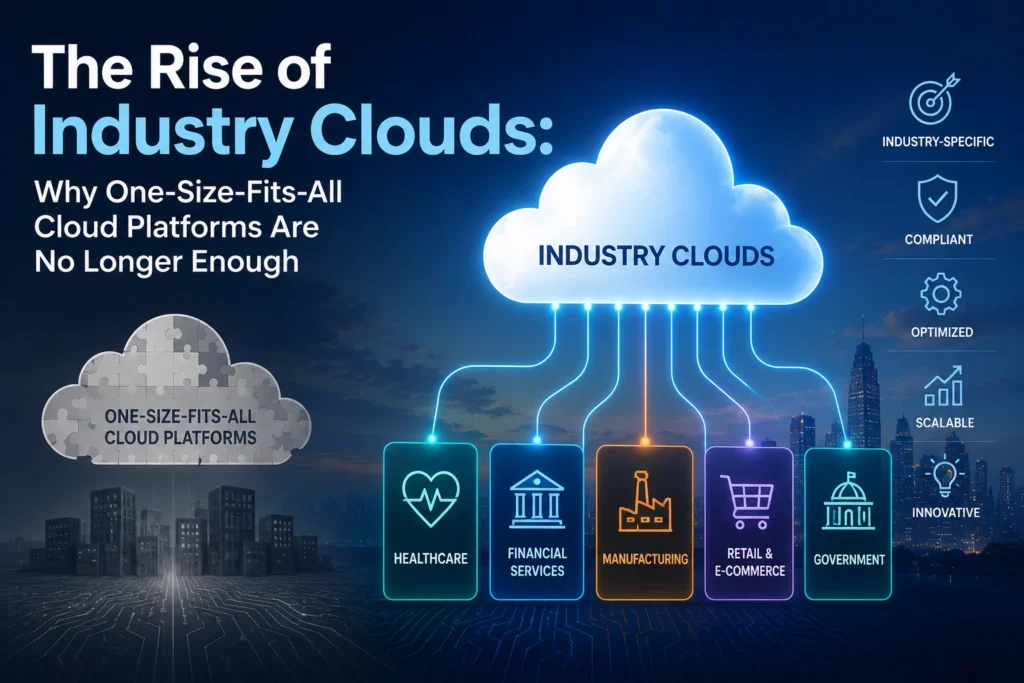
As a result, organizations are increasingly adopting a new model known as the Industry Cloud.
Rather than offering general-purpose infrastructure alone, industry clouds combine cloud technology with industry-specific capabilities, compliance frameworks, workflows, and data models.
Many analysts believe industry clouds will become one of the fastest-growing segments of enterprise technology over the next several years.
Understanding the Industry Cloud Concept
Traditional cloud platforms provide foundational services such as computing, storage, networking, and application hosting.
Industry clouds build on these capabilities by adding specialized functionality designed for a particular sector.
Instead of requiring businesses to customize everything themselves, industry clouds offer pre-built capabilities tailored to industry needs.
For example:
Healthcare Organizations May Receive:
- Patient data management frameworks
- Healthcare interoperability tools
- Compliance-ready infrastructure
- Clinical workflow support
Financial Institutions May Gain:
- Fraud detection frameworks
- Risk management tools
- Regulatory reporting capabilities
- Secure transaction processing systems
This significantly reduces implementation complexity and accelerates digital initiatives.
Why Industry Clouds Are Growing Rapidly
Several business trends are driving adoption.
The first is increasing regulatory complexity.
Organizations across healthcare, finance, insurance, and government sectors face growing compliance requirements. Building compliance-ready systems from scratch can be expensive and time-consuming.
Industry clouds help reduce this burden by incorporating industry standards directly into the platform architecture.
Another major factor is the demand for faster digital transformation.
Businesses no longer have years to build new systems. Competitive pressure requires organizations to launch products, services, and innovations quickly.
Industry-specific cloud platforms allow companies to start with proven foundations instead of reinventing common capabilities.
The rise of AI is also contributing to adoption.
Many organizations want to leverage AI but lack the specialized industry datasets and workflows necessary for effective implementation.
Industry clouds increasingly include AI-ready architectures tailored to sector-specific use cases.
How Different Industries Are Benefiting
Healthcare
Healthcare has emerged as one of the strongest adopters of industry cloud strategies.
Healthcare providers need secure environments that support:
- Electronic health records
- Telemedicine applications
- Patient engagement systems
- Healthcare analytics
Industry clouds simplify the deployment of these capabilities while helping organizations meet compliance requirements.
Financial Services
Financial institutions are also accelerating adoption.
Banks and fintech companies require secure, highly regulated environments capable of supporting:
- Digital banking
- Payment ecosystems
- Fraud prevention
- Customer analytics
Industry-specific cloud solutions provide many of these capabilities as integrated services.
Manufacturing
Manufacturing organizations are leveraging industry clouds to support:
- Smart factories
- Industrial IoT
- Predictive maintenance
- Supply chain visibility
These capabilities help manufacturers modernize operations while improving efficiency.
Retail & E-commerce
Retail and e-commerce companies are increasingly using industry clouds to enhance:
- Omnichannel commerce
- Customer personalization
- Inventory optimization
- Demand forecasting
The ability to combine operational data with advanced analytics creates significant business value.
The Business Benefits Extend Beyond Technology
Many executives initially view industry clouds as an infrastructure decision.
In reality, the impact extends far beyond IT departments.
Organizations implementing industry cloud strategies often experience faster product launches because many common capabilities are already available.
Operational efficiency improves because business processes align more closely with industry best practices.
Development teams spend less time building foundational components and more time creating differentiated customer experiences.
Perhaps most importantly, businesses gain greater agility.
When market conditions change, organizations can adapt more quickly because the underlying platform already supports many industry-specific requirements.
Industry Clouds and Artificial Intelligence
One reason industry clouds are attracting so much attention in 2026 is their growing relationship with AI.
Successful AI initiatives depend on more than algorithms.
They require:
- Industry-specific data
- Business context
- Compliance controls
- Domain expertise
Industry clouds provide the foundation necessary to deploy AI solutions effectively.
For example, healthcare AI requires clinical context and regulatory safeguards. Financial AI requires risk controls and auditability.
Generic platforms often struggle to provide these capabilities out of the box.
Industry clouds increasingly bridge this gap.
Organizations Must Still Navigate Several Challenges
Despite their advantages, industry cloud adoption requires careful planning.
Vendor selection becomes particularly important.
Businesses should evaluate whether a platform aligns with both current requirements and future growth objectives.
Integration planning is another critical consideration.
Most organizations operate multiple systems across different departments. Ensuring smooth interoperability remains essential.
Data governance must also remain a priority.
Industry-specific solutions often manage highly sensitive information, making security, privacy, and compliance central to long-term success.
The Market Is Moving Toward Specialized Digital Ecosystems
The broader trend behind industry clouds is the shift from generic technology platforms toward specialized digital ecosystems.
Organizations increasingly want solutions that understand their industry, their customers, and their operational challenges.
Instead of spending years customizing technology, businesses are looking for platforms that accelerate outcomes.
Industry clouds represent a major step in that direction.
How Our Company Helps Organizations Build Industry-Specific Digital Platforms
At our company, we help businesses design and implement cloud solutions tailored to their unique industry requirements.
Our expertise includes:
- Healthcare software development
- SaaS platform engineering
- ERP and CRM solutions
- AI integration
- Cloud-native application development
- Enterprise modernization
We help organizations build scalable digital ecosystems that support long-term growth and innovation.
Final Thoughts
The future of cloud computing is becoming increasingly specialized.
While general-purpose cloud platforms will continue to play an important role, organizations are recognizing that industry-specific capabilities create faster business value.
Industry clouds combine technology, compliance, workflows, and intelligence into solutions designed for real-world business challenges.
Companies that adopt these platforms effectively will be better positioned to accelerate innovation, improve efficiency, and compete in increasingly digital markets.
The next phase of cloud transformation is not simply about moving to the cloud.
It is about moving to a cloud that understands your industry.