
Digital Employees: The Workforce Revolution Every Business Needs to Understand
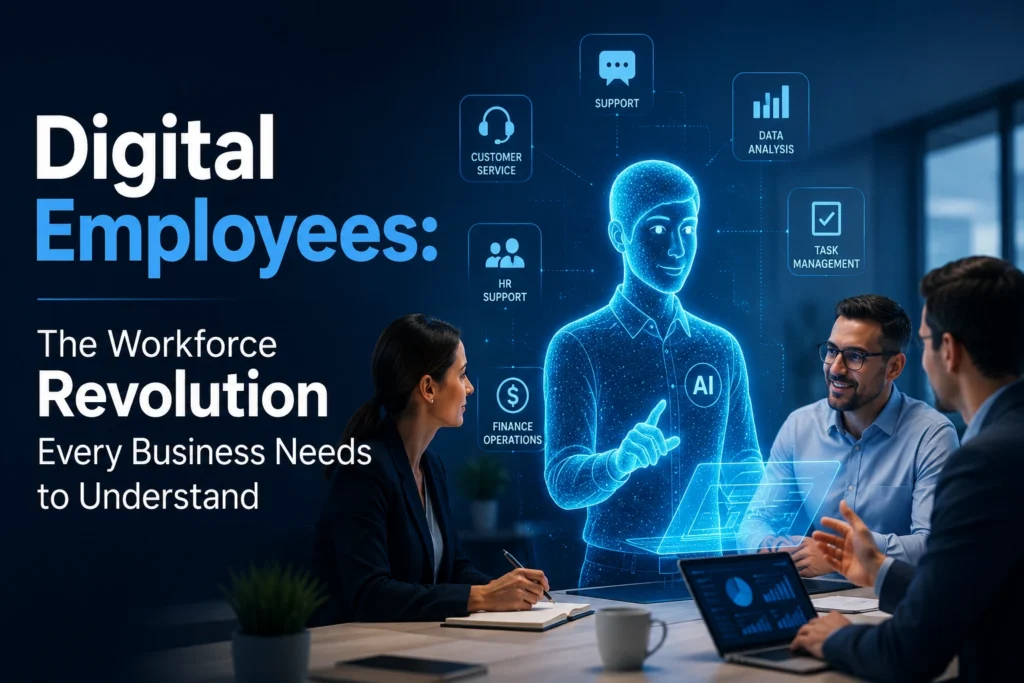
The Rise of Digital Employees in 2026: How AI-Powered Workers Are Transforming Business Operations
“`
How AI-Powered Digital Workers Are Transforming Operations, Productivity, and Business Growth
For over a century, business growth followed a predictable formula:
More customers → More work → More employees
As organizations expanded, they hired additional staff to manage increasing operational complexity.
However, in 2026, a new workforce model is emerging.
Companies are beginning to scale without significantly increasing headcount.
The reason?
Digital Employees
Powered by AI, automation, and intelligent workflows, digital employees are becoming a practical reality across industries.
Unlike traditional software, digital employees don’t simply provide tools for people to use.
They perform tasks, execute workflows, communicate with systems, and support business operations much like human team members.
This shift is redefining productivity and creating entirely new operating models.
What Is a Digital Employee?
A digital employee is an AI-powered system designed to perform specific business roles autonomously.
Unlike a chatbot that simply answers questions, a digital employee can:
- Analyze information
- Make decisions
- Complete tasks
- Communicate with systems
- Trigger workflows
- Learn from interactions
Think of them as specialized virtual workers assigned to particular business functions.
Examples include:
- Customer support agents
- HR assistants
- Sales coordinators
- Finance analysts
- IT support specialists
These systems work alongside human teams rather than replacing them entirely.
Why Digital Employees Are Trending in 2026
Rising Labor Costs
Organizations worldwide continue facing increasing operational expenses.
Businesses are searching for ways to:
- Improve efficiency
- Reduce repetitive work
- Scale operations economically
Digital employees help achieve these goals without proportional workforce growth.
AI Technology Has Matured
Recent advancements in generative AI and intelligent automation allow systems to:
- Understand language
- Interpret business context
- Execute multi-step processes
- Interact across applications
This makes digital employees far more capable than traditional automation systems.
Talent Shortages
Many industries continue facing shortages of skilled professionals.
Organizations are increasingly using AI-driven workers to support overloaded teams and fill operational gaps.
How Digital Employees Work
Digital employees operate through a combination of technologies.
These typically include:
- Artificial Intelligence
- Workflow Automation
- Business Rules Engines
- Enterprise Integrations
- Analytics Platforms
They interact with systems such as:
- Salesforce
- SAP
- Microsoft Dynamics 365
Allowing them to perform work across multiple business systems.
Real-World Business Applications
Customer Service Digital Employees
These systems can:
- Answer customer inquiries
- Process requests
- Update records
- Escalate complex issues
Benefits include:
- Faster response times
- 24/7 availability
- Reduced support costs
HR Digital Employees
Organizations are using AI-powered HR assistants to:
- Screen resumes
- Schedule interviews
- Manage onboarding workflows
- Answer employee questions
This reduces administrative burden on HR teams.
Finance Digital Employees
Digital workers assist with:
- Invoice validation
- Expense reviews
- Financial reporting
- Compliance monitoring
This improves accuracy and operational efficiency.
Sales Operations Digital Employees
AI-powered sales assistants can:
- Qualify leads
- Schedule meetings
- Update CRM records
- Generate follow-up communications
Sales teams gain more time for relationship building and closing deals.
Data Insight: Why Businesses Are Investing
Organizations implementing digital employee strategies often report:
- Higher Productivity – Teams spend more time on strategic activities.
- Faster Operations – Tasks are completed in minutes instead of hours.
- Lower Operational Costs – Automation reduces repetitive manual work.
- Improved Scalability – Organizations can support growth without proportional staffing increases.
The result is a more agile and efficient business model.
Digital Employees vs Traditional Automation
| Traditional Automation | Digital Employees |
|---|---|
| Task-focused | Role-focused |
| Rule-based | Context-aware |
| Limited adaptability | Dynamic decision-making |
| Process execution | Workflow ownership |
| Minimal learning | Continuous improvement |
Digital employees bring intelligence and adaptability to automation.
Industries Leading Adoption
Healthcare
Managing scheduling, patient communication, and administrative operations.
Financial Services
Supporting compliance, fraud monitoring, and transaction processing.
Real Estate
Handling inquiries, lead qualification, and customer engagement.
SaaS Companies
Managing support, onboarding, and customer success operations.
Manufacturing
Supporting supply chain coordination and operational workflows.
Challenges Businesses Must Address
Governance
Organizations need clear policies regarding:
- Decision authority
- Human oversight
- Accountability
Data Security
Digital employees often access sensitive business information.
Strong security controls are essential.
Employee Adoption
Companies must position AI as a productivity partner rather than a workforce threat.
Successful change management is critical.
The Future: Hybrid Workforces
The future workplace will likely consist of:
Human Employees
Focused on:
- Creativity
- Leadership
- Strategy
- Relationship building
Digital Employees
Focused on:
- Repetitive processes
- Administrative tasks
- Data analysis
- Workflow execution
This hybrid model combines human strengths with machine efficiency.
How Our Company Helps Organizations Build Digital Workforce Solutions
At our company, we help businesses implement intelligent automation and AI-powered workforce strategies.
Our expertise includes:
- AI agent development
- Enterprise automation
- Workflow orchestration
- System integration
- Digital transformation consulting
We help organizations create scalable operations that support future growth.
Final Thoughts
Digital employees represent one of the most significant workplace innovations of the decade.
They are transforming how organizations think about:
- Productivity
- Workforce planning
- Operational efficiency
- Scalability
Businesses that successfully integrate digital employees into their operations will gain a significant competitive advantage in the years ahead.
In the future, workforce growth will not be measured only by the number of people a company hires.
It will also be measured by the number of intelligent digital workers it deploys.