
Ambient Intelligence in 2026: How Smart Environments Are Redefining Human–Technology Interaction
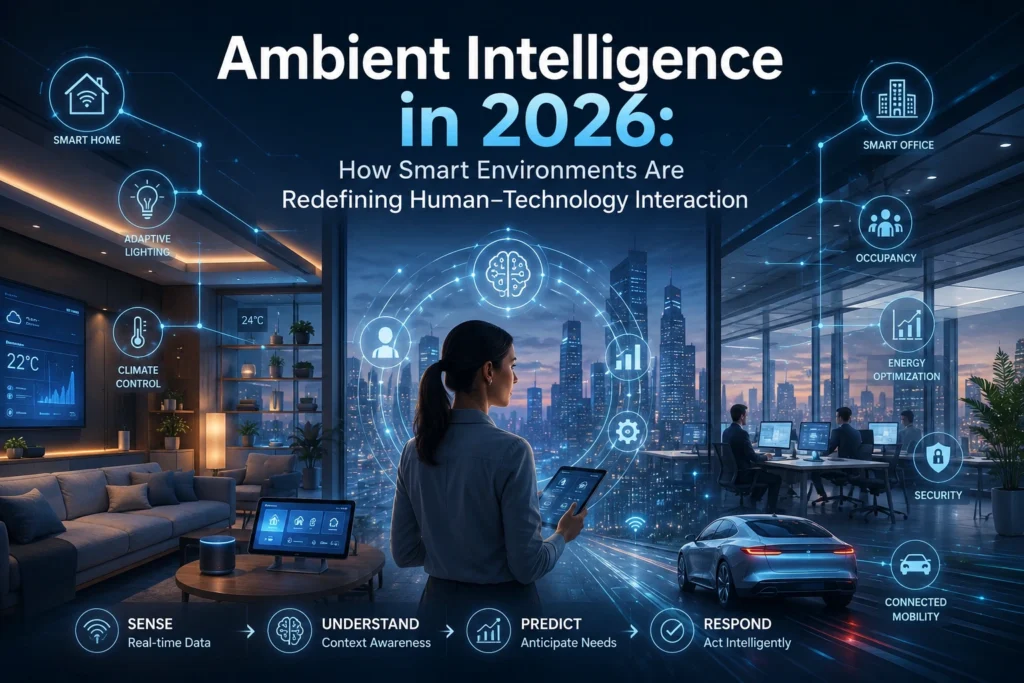
For decades, technology required active human interaction.
People clicked buttons, opened applications, entered commands, and manually controlled digital systems.
But in 2026, technology is evolving toward something far more seamless:
environments that can sense human behavior, understand context, and respond automatically, often without direct input.
This emerging paradigm is called Ambient Intelligence (AmI).
Ambient Intelligence is transforming homes, workplaces, healthcare systems, retail spaces, factories, and entire cities into intelligent environments that continuously adapt to human needs.
Instead of humans adapting to technology, technology is beginning to adapt to humans.
What Is Ambient Intelligence?
Ambient Intelligence refers to digital environments embedded with:
- Sensors
- AI systems
- IoT devices
- Real-time analytics
- Context-aware computing
These systems work together to create environments that can:
- Detect activity
- Interpret behavior
- Predict needs
- Respond intelligently
often in real time and with minimal user interaction.
Why Ambient Intelligence Is Trending in 2026
1. Explosion of Connected Devices
Billions of IoT devices are now integrated into:
- Homes
- Offices
- Vehicles
- Factories
- Public infrastructure
These devices continuously generate contextual data about users and environments.
2. AI Has Become More Context-Aware
Modern AI systems can now:
- Understand behavioral patterns
- Analyze environmental signals
- Make predictive decisions
This allows environments to become increasingly adaptive and autonomous.
3. Demand for Frictionless Experiences
Consumers increasingly expect:
- Seamless interactions
- Personalization
- Instant responsiveness
The future user experience is moving toward “Invisible Interfaces” where technology operates naturally in the background.
How Ambient Intelligence Works
Ambient Intelligence systems combine multiple technologies into one intelligent ecosystem.
Sensors & Data Collection
Devices gather real-time information such as:
- Movement
- Temperature
- Voice
- Location
- Behavioral activity
AI & Context Processing
AI models analyze environmental data to understand:
- User preferences
- Intentions
- Situational context
Automated Decision Systems
Based on context, systems trigger intelligent responses automatically.
Examples include:
- Adjusting room lighting
- Recommending actions
- Optimizing energy usage
- Sending alerts
Real-World Use Cases of Ambient Intelligence
Smart Healthcare
Healthcare environments use ambient intelligence to:
- Monitor patients continuously
- Detect emergencies automatically
- Track behavioral changes
Hospitals are increasingly integrating intelligent monitoring systems to improve patient outcomes.
Smart Offices
Modern workplaces are becoming adaptive environments that optimize:
- Lighting
- Energy usage
- Workspace allocation
- Meeting room management
based on real-time occupancy and behavior patterns.
Retail Personalization
Retailers are using ambient systems to:
- Analyze in-store customer movement
- Deliver personalized promotions
- Optimize product placement
Physical retail is becoming data-driven and responsive.
Smart Homes
Homes equipped with intelligent ecosystems can:
- Adjust climate automatically
- Optimize energy consumption
- Predict user routines
- Enhance security systems
Technologies Powering Ambient Intelligence
Modern ambient intelligence systems rely on technologies such as:
- Google Home
- Amazon Alexa
- Azure AI
These platforms combine AI, cloud computing, and IoT infrastructure.
Data Insight: Why Businesses Are Investing in Ambient Intelligence
Organizations adopting intelligent environments are seeing improvements in:
- Operational efficiency
- User experience
- Resource optimization
- Predictive maintenance
- Energy management
The ability to make environments adaptive creates significant business value.
Ambient Intelligence vs Traditional Smart Systems
| Traditional Smart Systems | Ambient Intelligence |
|---|---|
| Reactive automation | Predictive intelligence |
| User-controlled | Context-aware autonomy |
| Device-focused | Environment-focused |
| Explicit interaction | Invisible interaction |
Ambient intelligence moves technology from “tools” to “intelligent environments.”
Key Business Benefits
Personalized User Experiences
Systems adapt dynamically to individual behaviors and preferences.
Operational Efficiency
Organizations optimize resources automatically using real-time environmental data.
Predictive Decision-Making
AI systems anticipate needs before users explicitly request actions.
Energy Optimization
Intelligent environments reduce unnecessary energy consumption significantly.
Challenges Businesses Must Address
Privacy & Data Security
Ambient systems continuously collect sensitive environmental and behavioral data.
Strong governance and security become critical.
Infrastructure Complexity
Deploying large-scale intelligent environments requires integrated IoT, AI, and cloud ecosystems.
Ethical Concerns
Businesses must balance convenience with transparency and responsible AI practices.
The Future: Invisible Computing
Ambient intelligence represents a broader shift toward “Invisible Computing” where technology disappears into the environment itself.
In the future:
- Interfaces will become less visible
- Systems will become more predictive
- Environments will operate autonomously
Technology will increasingly become part of the physical world around us rather than something users actively operate.
How Our Company Helps Businesses Build Intelligent Environments
At our company, we help organizations develop scalable ambient intelligence solutions tailored to modern business needs.
Our expertise includes:
- AI-driven environment systems
- IoT ecosystem integration
- Real-time analytics platforms
- Smart automation architecture
We help businesses create environments that are:
- ✅ Intelligent
- ✅ Adaptive
- ✅ Efficient
- ✅ Future-ready
Final Thoughts
Ambient Intelligence is becoming one of the defining technology trends of 2026.
As AI, IoT, and real-time analytics continue evolving, environments themselves are becoming increasingly intelligent.
Businesses that invest early in adaptive digital ecosystems will gain major advantages in:
- Customer experience
- Operational efficiency
- Resource optimization
- Innovation capability
The future of technology is no longer just digital — it is embedded into the world around us.