
Green Software Engineering in 2026: Why Sustainable Technology Is Becoming a Business Priority
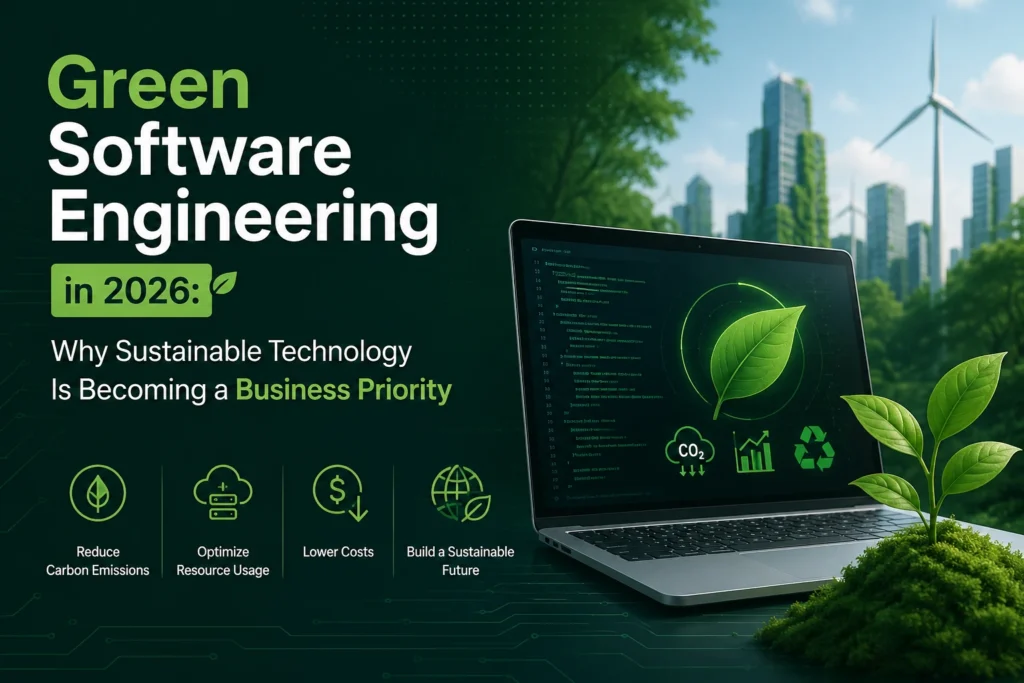
Green Software Engineering in 2026: Building Sustainable Digital Infrastructure
How Companies Are Reducing Carbon Emissions Through Smarter Software Architecture
For years, conversations around sustainability focused mainly on industries like manufacturing, transportation, and energy.
But in 2026, a new reality is becoming impossible to ignore:
Software and digital infrastructure also have a significant environmental impact.
Every cloud request, database query, AI model, streaming service, and application workload consumes electricity through data centers, networks, and computing infrastructure.
As businesses scale digitally, energy consumption is increasing rapidly — and organizations are now under pressure to build not only fast and scalable software, but also sustainable software.
This shift has given rise to one of the most important emerging trends in modern technology:
Green Software Engineering
What Is Green Software Engineering?
Green Software Engineering is the practice of designing, developing, and operating software in ways that minimize environmental impact.
The goal is to reduce:
- Energy consumption
- Carbon emissions
- Infrastructure waste
- Inefficient computing operations
while still maintaining:
- Performance
- Scalability
- Reliability
It combines software engineering with sustainability strategy.
Why Sustainability Is Becoming a Technology Issue
Modern digital systems consume enormous amounts of energy.
Consider how businesses now rely heavily on:
- Cloud computing
- AI workloads
- Real-time analytics
- Streaming platforms
- IoT ecosystems
Large-scale data centers supporting these operations require massive electricity consumption for:
- Computing
- Cooling
- Networking
As digital adoption accelerates globally, software efficiency directly impacts environmental sustainability.
Why Green Software Engineering Is Trending in 2026
1. Rising Energy Costs
Cloud infrastructure costs are increasing globally due to higher energy demand.
Businesses are now looking for ways to:
- Optimize workloads
- Reduce infrastructure waste
- Improve computing efficiency
Efficient software directly lowers operational costs.
2. ESG & Sustainability Regulations
Organizations are increasingly evaluated based on:
- Environmental impact
- Sustainability reporting
- Carbon reduction initiatives
Technology operations now contribute significantly to corporate ESG strategies.
3. AI & Data Processing Growth
AI systems require enormous computational power.
Training and operating large AI models consume substantial energy resources.
As AI adoption grows, sustainable computing becomes essential.
The Hidden Environmental Cost of Software
Many businesses underestimate how software architecture affects sustainability.
Poorly optimized systems often create:
- Excessive cloud usage
- Unnecessary database operations
- Redundant processing
- Over-scaled infrastructure
Even small inefficiencies multiplied across millions of users create large environmental impacts.
Inefficient software equals unnecessary energy consumption.
Core Principles of Green Software Engineering
Energy-Efficient Code
Optimized code reduces:
- CPU usage
- Memory consumption
- Processing time
This lowers infrastructure demand.
Efficient Cloud Architecture
Modern cloud optimization strategies include:
- Auto-scaling
- Serverless computing
- Workload scheduling
- Resource optimization
Platforms like:
- Amazon Web Services
- Google Cloud
now provide sustainability-focused infrastructure tools.
Carbon-Aware Computing
Some systems now schedule workloads based on:
- Renewable energy availability
- Grid carbon intensity
- Regional energy efficiency
This reduces environmental impact without affecting performance.
Sustainable Data Management
Data storage consumes significant energy.
Businesses are improving sustainability by:
- Removing duplicate data
- Archiving inactive records
- Optimizing storage strategies
Real-World Business Use Cases
Cloud Optimization
Organizations reduce infrastructure waste through:
- Containerization
- Dynamic scaling
- Efficient workload distribution
Sustainable AI Operations
Businesses optimize AI models to:
- Reduce processing requirements
- Lower GPU usage
- Improve inference efficiency
Energy-Efficient Mobile Applications
Developers optimize apps to:
- Reduce battery usage
- Minimize background processing
- Lower network consumption
This improves both sustainability and user experience.
Data Insight: Business Impact of Sustainable Software
Organizations implementing green engineering practices are reporting:
- Lower cloud infrastructure costs
- Reduced energy consumption
- Improved operational efficiency
- Stronger ESG positioning
Sustainability is becoming a competitive business differentiator.
Green Software vs Traditional Software Development
| Traditional Development | Green Software Engineering |
|---|---|
| Focus on functionality & speed | Focus on efficiency + sustainability |
| Resource-heavy systems | Optimized resource usage |
| Infrastructure over-scaling | Intelligent scaling |
| Energy ignored | Energy considered in architecture |
Sustainability becomes part of software design decisions.
Challenges Businesses Must Address
Despite its importance, sustainable software engineering introduces new complexities.
Measuring Carbon Impact
Tracking software-related emissions requires advanced monitoring tools and analytics.
Balancing Performance & Efficiency
Businesses must optimize systems without negatively impacting user experience.
Organizational Awareness
Many teams still lack visibility into how software architecture affects sustainability.
The Future: Sustainability as a Core Engineering Metric
In the coming years, businesses will increasingly evaluate software not only by:
- Performance
- Scalability
- Security
but also by:
- Energy efficiency and environmental impact
Sustainability will become a core engineering KPI.
How Our Company Helps Businesses Build Sustainable Digital Systems
At our company, we help organizations create scalable and environmentally efficient software architectures.
Our expertise includes:
- Cloud optimization
- Sustainable infrastructure design
- Efficient application architecture
- Green software consulting
We help businesses build systems that are:
- ✅ High-performance
- ✅ Scalable
- ✅ Cost-efficient
- ✅ Environmentally sustainable
Final Thoughts
Green Software Engineering is no longer a niche concept, it is becoming a critical part of modern digital strategy.
As businesses continue scaling cloud, AI, and data-driven operations, sustainable engineering practices will play a major role in:
- Cost optimization
- ESG compliance
- Operational efficiency
- Long-term scalability
In 2026, the future of software is not only smart and scalable, it is also sustainable.