
Hyperautomation in 2026: How Businesses Are Automating Entire Decision Chains – Not Just Tasks
Hyperautomation in 2026: How Businesses Are Automating Entire Operations with AI
The next evolution beyond traditional automation is already transforming how modern businesses operate.
For years, businesses focused on automating repetitive tasks:
- Data entry
- Invoice processing
- Email workflows
- Report generation
While these improvements increased efficiency, they solved only part of the problem.
In 2026, organizations are facing a much larger challenge:
Modern business operations are becoming too complex for isolated automation tools.
Companies now need systems that can automate entire workflows, departments, and decision chains across the organization.
This is why one of the most important enterprise technology trends today is:
Hyperautomation
Hyperautomation is redefining how modern businesses operate by combining AI, automation, analytics, and orchestration into intelligent end-to-end systems.
What Is Hyperautomation?
Hyperautomation is a business-driven approach that combines multiple technologies to automate not only tasks but complete business processes.
It integrates:
- Artificial Intelligence (AI)
- Robotic Process Automation (RPA)
- Machine Learning
- Workflow orchestration
- Process mining
- Analytics platforms
The goal is simple:
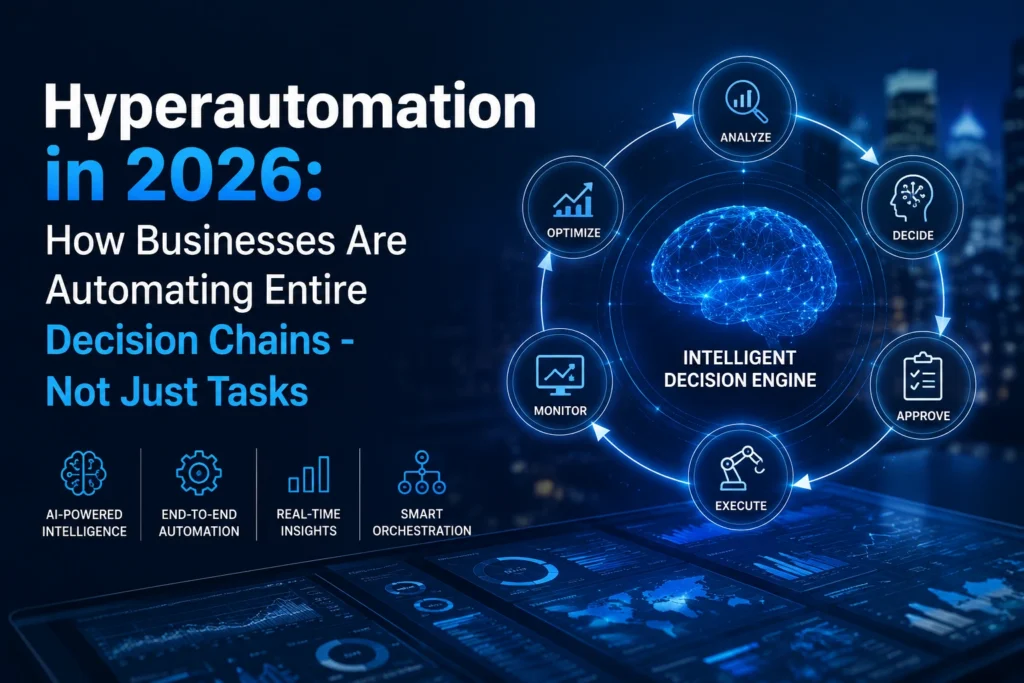
Create systems that can analyze, decide, execute, and optimize processes automatically.
Why Traditional Automation Is No Longer Enough
Traditional automation works well for predictable, rule-based tasks.
But modern enterprises operate with:
- Dynamic workflows
- Cross-department dependencies
- Real-time data
- Complex decision-making
For example:
A customer refund request may involve:
- CRM systems
- Fraud detection
- Payment platforms
- Approval workflows
- Inventory systems
Simple automation cannot manage this complexity efficiently.
Hyperautomation can.
Why Hyperautomation Is Trending in 2026
1. Pressure to Increase Operational Efficiency
Businesses are expected to:
- Deliver faster services
- Reduce operational costs
- Scale without increasing workforce size
Hyperautomation enables organizations to automate large portions of operations without proportional staffing increases.
2. Explosion of Enterprise Data
Organizations now generate massive amounts of operational data.
Hyperautomation systems use this data to:
- Identify inefficiencies
- Predict outcomes
- Trigger automated actions
3. AI Maturity Has Increased
AI models are now capable of:
- Understanding language
- Analyzing patterns
- Supporting decision-making
This allows automation to move beyond fixed rules into adaptive workflows.
Core Components of Hyperautomation
Hyperautomation combines several technologies into one intelligent ecosystem.
Robotic Process Automation (RPA)
Tools like:
- UiPath
- Automation Anywhere
automate repetitive digital tasks.
Artificial Intelligence
AI systems enable:
- Decision-making
- Pattern recognition
- Predictive analysis
Process Mining
Process mining tools analyze operational workflows to identify inefficiencies automatically.
Popular platforms include:
- Celonis
Workflow Orchestration
Orchestration platforms connect systems, teams, and automated workflows into unified business operations.
Real-World Business Use Cases
Customer Service Automation
Hyperautomation enables systems to:
- Analyze customer intent
- Retrieve account data
- Detect urgency
- Resolve issues automatically
Result: Faster support and reduced operational workload.
Financial Operations
Businesses automate:
- Invoice processing
- Fraud detection
- Compliance checks
- Payment approvals
with minimal human involvement.
Supply Chain Optimization
Hyperautomation systems can:
- Predict inventory shortages
- Adjust procurement automatically
- Optimize logistics routes in real time
HR & Employee Operations
Companies automate:
- Recruitment workflows
- Employee onboarding
- Payroll approvals
- Performance reporting
Data Insight: Business Impact of Hyperautomation
Organizations implementing hyperautomation strategies are reporting:
- Major reductions in operational costs
- Faster process execution
- Improved workflow accuracy
- Higher organizational scalability
More importantly:
Hyperautomation shifts businesses from “manual operations” to “intelligent operations.”
Hyperautomation vs Traditional Automation
| Traditional Automation | Hyperautomation |
|---|---|
| Automates individual tasks | Automates entire workflows |
| Rule-based execution | AI-driven decision-making |
| Limited integration | Cross-system orchestration |
| Static processes | Adaptive and scalable processes |
Hyperautomation brings intelligence and coordination into automation.
Strategic Benefits for Businesses
Faster Decision-Making
AI-driven workflows reduce delays and bottlenecks.
Lower Operational Costs
Businesses automate high-volume operational work at scale.
Improved Customer Experience
Faster and more accurate services improve user satisfaction.
Greater Scalability
Organizations can scale operations without proportional workforce growth.
Challenges Businesses Must Consider
Integration Complexity
Modern enterprises often operate across multiple disconnected systems.
Integrating them into unified workflows requires strong technical architecture.
Change Management
Employees and teams must adapt to new operational models.
Data Quality Issues
Hyperautomation depends heavily on clean and reliable data sources.
Poor data leads to poor automation outcomes.
The Future: Autonomous Business Operations
Hyperautomation is leading toward a future where businesses become increasingly autonomous.
In the coming years:
- AI systems will make operational decisions
- Workflows will self-optimize
- Processes will adapt dynamically in real time
This is creating a new generation of:
Autonomous Enterprises
How Our Company Helps Businesses Implement Hyperautomation
At our company, we help organizations modernize operations through intelligent automation strategies.
Our expertise includes:
- Hyperautomation consulting
- AI-driven workflow design
- Enterprise system integration
- Intelligent process optimization
We help businesses build systems that are:
- ✅ Faster
- ✅ Smarter
- ✅ Scalable
- ✅ Future-ready
Final Thoughts
Hyperautomation is becoming one of the defining enterprise technology strategies of 2026.
Businesses are no longer focusing only on task automation — they are automating entire operational ecosystems.
Organizations that adopt hyperautomation early will gain major advantages in:
- Efficiency
- Scalability
- Cost optimization
- Decision-making speed
The future of business operations is no longer manual — it is intelligent, connected, and autonomous.