
Data Mesh in 2026: Why Enterprises Are Rethinking Centralized Data Architecture
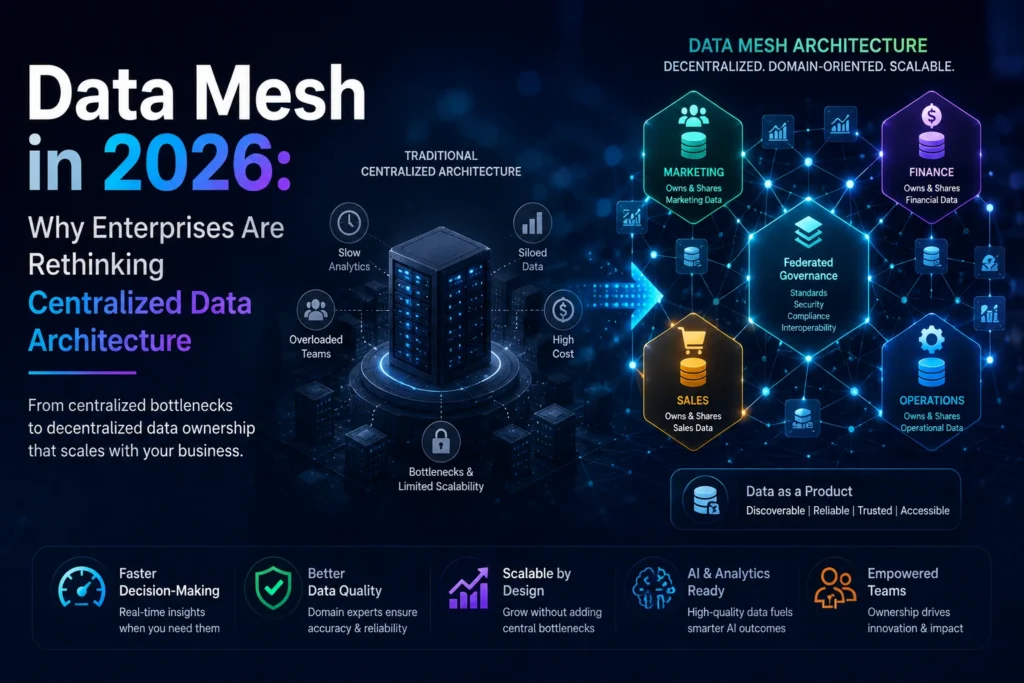
Data Mesh in 2026: The Future of Scalable Enterprise Data Architecture
Over the last decade, businesses have invested heavily in collecting data.
From customer interactions and operational systems to IoT devices and digital platforms, organizations today generate more data than ever before.
Yet despite having enormous amounts of information, many enterprises still struggle with a major problem:
their data architecture cannot scale efficiently.
Centralized data systems often become bottlenecks, slowing analytics, delaying decision-making, and limiting innovation.
This challenge has led to the rise of one of the most important enterprise data strategies in 2026:
Data Mesh.
Data Mesh is changing how organizations manage, distribute, and scale data across modern enterprises.
The Problem with Traditional Centralized Data Architectures
Historically, companies built centralized data systems where all business data flowed into a single platform managed by one central team.
While this worked initially, modern enterprises now face several challenges:
- Massive data volume growth
- Increasing complexity of business systems
- Slow reporting cycles
- Overloaded central data teams
- Poor scalability for analytics initiatives
As organizations expand, centralized models become difficult to maintain.
What Is Data Mesh?
Data Mesh is a decentralized approach to data architecture where different business domains take ownership of their own data.
Instead of one centralized data team controlling everything:
- Marketing manages marketing data
- Finance manages financial data
- Operations manage operational data
Each domain treats its data as a product that can be securely shared across the organization.
Core Principles of Data Mesh
Data Mesh is built on four key principles.
1. Domain-Oriented Ownership
Each business domain owns and manages its own data pipelines and datasets.
This reduces dependency on centralized teams and improves agility.
2. Data as a Product
Data is treated like a product with:
- Quality standards
- Documentation
- Accessibility
- Reliability
This improves trust and usability across teams.
3. Self-Service Data Infrastructure
Organizations build platforms that allow teams to:
- Publish data easily
- Access analytics tools
- Create pipelines independently
This democratizes data access across the enterprise.
4. Federated Governance
While ownership is decentralized, governance standards remain consistent across the organization.
This ensures:
- Security
- Compliance
- Interoperability
Why Data Mesh Is Trending in 2026
Explosion of Enterprise Data
Businesses now process data from:
- Cloud applications
- Mobile platforms
- IoT systems
- AI applications
- Customer interactions
Traditional centralized systems struggle to handle this scale efficiently.
AI & Real-Time Analytics Demands
AI systems require:
- High-quality data
- Faster access to datasets
- Real-time processing capabilities
Data Mesh enables domains to provide cleaner and more accessible data pipelines.
Organizational Scalability
As enterprises grow globally, centralized teams become bottlenecks.
Data Mesh distributes responsibility, improving scalability across departments.
Technologies Supporting Data Mesh
Modern Data Mesh implementations often rely on platforms such as:
- Snowflake
- Databricks
- Apache Kafka
These technologies help organizations build scalable and distributed data ecosystems.
Real-World Business Example
Consider a global e-commerce company.
In a traditional centralized system:
- Marketing requests customer insights from a central data team
- Operations request inventory analytics separately
- Delays occur due to overloaded workflows
With Data Mesh:
- Marketing owns customer engagement datasets
- Operations own supply chain datasets
- Teams access and share data independently
Data Mesh vs Traditional Data Warehousing
| Traditional Data Warehouse | Data Mesh |
|---|---|
| Centralized ownership | Decentralized ownership |
| Single data team | Domain-based teams |
| Slower scalability | Highly scalable |
| Bottleneck risk | Distributed responsibility |
| Centralized pipelines | Domain-managed pipelines |
Business Benefits of Data Mesh
Faster Decision-Making
Teams access domain-specific insights without waiting for centralized processing.
Improved Data Quality
Domain experts better understand and manage their own datasets.
Greater Scalability
Distributed ownership reduces operational bottlenecks.
Stronger AI Readiness
AI systems perform better with cleaner, domain-owned data.
Challenges Businesses Must Address
Cultural Transformation
Teams must shift toward ownership responsibility.
Governance Complexity
Maintaining consistent standards across decentralized systems requires strong governance frameworks.
Technical Maturity
Organizations need modern infrastructure, APIs, and automation capabilities.
Why Data Mesh Matters for AI-Driven Enterprises
In 2026, enterprises are increasingly becoming:
- Data-driven
- AI-powered
- Real-time decision-oriented
Traditional architectures are often too rigid for these demands.
Data Mesh provides the flexibility and scalability needed for:
- Advanced analytics
- Machine learning
- Cross-functional collaboration
How Our Company Helps Businesses Build Scalable Data Architectures
At our company, we help organizations modernize their data ecosystems for the AI era.
Our expertise includes:
- Data Mesh architecture consulting
- Data platform modernization
- Cloud-native analytics systems
- Real-time data pipeline development
We help businesses transform raw data into scalable business intelligence systems.
Final Thoughts
Data Mesh is more than a technical architecture trend. It is a new operating model for data-driven enterprises.
As organizations continue scaling their analytics and AI initiatives, decentralized data ownership will become increasingly important.
Businesses that adopt modern data strategies early will gain major advantages in:
- Agility
- Analytics scalability
- AI readiness
- Faster decision-making
In 2026, successful enterprises are no longer just collecting data. They are building scalable ecosystems around it.