
Developer Experience in 2026: Building Better Software Teams
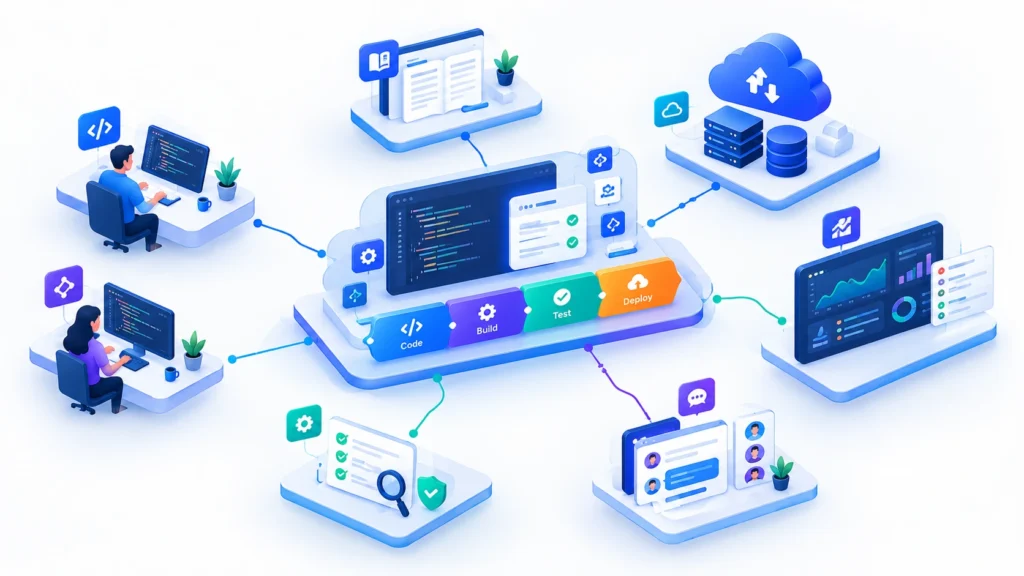
Developer Experience in 2026: How Better Engineering Workflows Help Teams Build and Deliver Better Software
Software development is evolving rapidly. Businesses are investing in
modern technologies, cloud infrastructure, automation, and AI-powered
development tools to build products faster. However, having access to
better tools does not automatically mean development teams can deliver
better software.
Developers still spend considerable time searching for information,
understanding existing code, resolving dependencies, attending
meetings, and dealing with complicated development processes. These
activities can slow down projects even when the actual coding work
becomes faster.
This is why developer experience is becoming an important part of
modern software engineering. Businesses are recognizing that
improving the way developers work can have a direct impact on software
quality, delivery speed, team collaboration, and long-term product
success.
What Is Developer Experience?
Developer experience, commonly known as DevEx, refers to the overall
experience developers have while building, testing, deploying, and
maintaining software.
It includes the tools they use, the documentation they access, the
development environments they work in, the processes they follow,
and the collaboration they have with other teams.
A positive developer experience allows engineers to focus more on
solving business problems and less on unnecessary technical
obstacles.
For example, imagine a development team working on a SaaS platform.
Every time a developer joins the project, they need several days to
configure the environment, understand the architecture, find API
documentation, and identify the correct deployment process.
With standardized environments, clear documentation, automated
testing, and consistent deployment workflows, much of this effort
can be reduced.
Developer experience is not simply about making developers happier.
It is about creating an engineering environment where teams can
produce reliable software with less friction.
Why Developer Experience Matters More in 2026
Modern software products involve multiple technologies, services,
integrations, and development teams. As systems become more complex,
coordination and operational processes can become major sources of
delay.
Atlassian’s 2026 State of Developer Experience research highlights
this challenge. Its report found that 87% of developers say AI helps
them ship work faster, while 72% experience the same or more friction
than before.
This demonstrates an important point: improving individual
productivity does not necessarily improve the entire software
delivery process.
Businesses need to examine the complete engineering workflow, from
understanding requirements to releasing and maintaining software.
1. Reduce Unnecessary Development Friction
One of the biggest obstacles to productive software development is
the time spent dealing with activities that do not directly
contribute to building or improving a product.
Developers may need to search through multiple documentation
platforms, wait for environment access, resolve unclear requirements,
or depend on other teams before completing a task.
These small delays can accumulate across a project and affect
delivery timelines.
Businesses can reduce this friction by:
- Providing centralized and searchable technical documentation.
- Standardizing project setup and development environments.
- Defining clear ownership for services and components.
- Reducing unnecessary approval steps.
- Improving communication between engineering and product teams.
- Making project requirements clear before implementation begins.
The objective is to help developers find the information and resources
they need without repeatedly interrupting their work.
2. Build Consistent Development Environments
Inconsistent development environments can create unnecessary
problems for engineering teams. An application may work correctly
on one developer’s machine but fail in another environment because
of differences in dependencies, configurations, or runtime versions.
Standardized environments help reduce these inconsistencies and
make collaboration easier.
Technologies such as Docker can package applications and their
dependencies into consistent environments. Infrastructure as code
can help teams provision development, testing, and production
infrastructure in a repeatable way.
A well-organized environment should include:
- Consistent runtime and dependency versions.
- Documented environment variables and configuration.
- Repeatable database setup and test data.
- Secure access to development services.
- Simple onboarding instructions for new developers.
When developers can start working without spending hours configuring
their systems, teams can reduce onboarding delays and avoid
environment-related defects.
3. Improve CI/CD and Automate Repetitive Tasks
Continuous Integration and Continuous Delivery or Deployment
(CI/CD) are important parts of modern software engineering.
They help teams automate the process of building, testing, and
releasing applications.
Without automation, developers may need to perform repetitive
activities manually, including running tests, preparing builds,
updating environments, and deploying new versions.
These processes consume time and can introduce human errors.
A well-designed CI/CD pipeline can include:
- Automated code quality checks.
- Unit and integration testing.
- Build and package automation.
- Dependency and security scanning.
- Automated deployment to appropriate environments.
- Deployment verification and rollback procedures.
Tools such as GitHub Actions, GitLab CI/CD, and Jenkins can support
these workflows depending on the project’s requirements.
Automation should not remove important quality controls. Instead,
it should make those controls consistent and easier to follow.
4. Introduce Platform Engineering Where It Makes Sense
As engineering organizations grow, individual teams may create
different approaches for managing infrastructure, deployments,
monitoring, and application environments.
This can lead to duplicated effort, inconsistent configurations,
and increased operational complexity.
Platform engineering addresses these challenges by creating shared
internal capabilities that help developers build and deliver
applications more efficiently.
An internal developer platform may provide:
- Standardized project templates.
- Reusable deployment pipelines.
- Infrastructure provisioning workflows.
- Centralized monitoring and logging.
- Service catalogs and technical documentation.
- Self-service access to approved development resources.
Instead of every team solving the same infrastructure problems
independently, developers can use established workflows and focus
on product-specific requirements.
However, platform engineering does not require every company to
build a large internal platform team. Smaller organizations can
begin with reusable templates, shared CI/CD pipelines, and
standardized infrastructure.
5. Make Documentation and Knowledge Sharing Easier
Technical knowledge is one of the most valuable resources within
a software development organization. Unfortunately, important
information is often distributed across code repositories,
conversations, documents, and individual team members.
When developers cannot easily find the information they need,
they spend additional time investigating existing functionality
or asking other team members for clarification.
Businesses can improve knowledge sharing by maintaining:
- Clear architecture diagrams and system overviews.
- API documentation and integration guides.
- Database structures and important data relationships.
- Deployment and troubleshooting instructions.
- Technical decision records.
- Onboarding documentation for new team members.
Documentation should remain connected to the development process.
Teams should update it when important architectural or operational
changes are introduced.
AI-powered search can also help developers locate relevant
information across approved internal knowledge sources, provided
access permissions and information accuracy are maintained.
6. Improve Collaboration Between Development and Product Teams
Software delivery depends on more than engineering implementation.
Developers need to understand business priorities, customer
expectations, and the problems a feature is intended to solve.
When requirements are incomplete or change frequently without
proper communication, development teams may spend time building
features that need significant rework.
Strong collaboration between product managers, designers,
developers, testers, and business stakeholders helps prevent
these problems.
Useful practices include:
- Defining clear acceptance criteria for development tasks.
- Reviewing technical feasibility before committing to timelines.
- Discussing dependencies early in the planning process.
- Maintaining transparent project priorities.
- Collecting feedback from developers during product planning.
- Reviewing completed work against the original business objective.
Better communication reduces uncertainty and allows teams to
concentrate on delivering useful product improvements.
7. Use AI Development Tools With Proper Engineering Practices
AI-powered development tools are changing how developers write,
review, test, and understand code. They can assist with repetitive
tasks, explain unfamiliar code, generate test cases, and help
developers explore implementation options.
However, AI-generated code still requires engineering judgment.
Incorrect assumptions, security weaknesses, and unnecessary
complexity can become part of a codebase if generated output is
accepted without review.
Businesses should establish clear practices for using AI tools:
- Review AI-generated code before merging changes.
- Run automated tests and security checks.
- Avoid sharing confidential information with unauthorized tools.
- Keep developers responsible for technical decisions.
- Measure actual delivery quality rather than tool usage alone.
- Use AI where it addresses a genuine development bottleneck.
AI should support developers and improve engineering workflows,
not replace the need for sound architecture, testing, and
accountability.
8. Measure Developer Experience and Engineering Performance
Improving developer experience requires understanding where teams
experience friction and whether changes are producing meaningful
results.
Businesses can use engineering metrics to identify bottlenecks
and evaluate improvements over time.
Useful measurements include:
-
Lead time for changes: How long it takes for
code changes to move from development to production. -
Deployment frequency: How often teams successfully
release software. -
Change failure rate: The proportion of deployments
that require remediation or cause production issues. -
Recovery time: How quickly teams restore normal
service after an incident. -
Developer feedback: How developers rate the
tools, processes, documentation, and environments they use. -
Onboarding time: How long new team members need
to become productive within a project.
These metrics should be used to identify system-level improvements,
not to rank individual developers or encourage teams to optimize
numbers at the expense of software quality.
A Practical Roadmap to Improve Developer Experience
Improving developer experience does not require changing every
tool or process at once. A phased approach helps businesses identify
the most important problems and make improvements without disrupting
ongoing development.
Phase 1: Understand the Current Workflow
Review how developers move from requirements and planning to coding,
testing, deployment, and maintenance. Identify repeated delays,
manual activities, unclear responsibilities, and common technical
obstacles.
Phase 2: Prioritize the Biggest Bottlenecks
Focus on issues that consume significant engineering time or create
delivery risks. This may include slow builds, difficult environment
setup, missing documentation, or unreliable deployment processes.
Phase 3: Standardize and Automate
Introduce reusable project templates, consistent development
environments, automated testing, and repeatable deployment
pipelines.
Phase 4: Improve Collaboration and Knowledge Sharing
Establish clear technical ownership, improve documentation,
involve developers in product planning, and make project
information easier to discover.
Phase 5: Measure and Continuously Improve
Compare engineering performance and developer feedback against
the initial baseline. Use the results to identify the next
improvements and adjust the approach as the organization grows.
Conclusion
Building better software is not only about writing code faster.
It also depends on how effectively development teams collaborate,
access information, manage infrastructure, test applications,
and deliver changes.
Developer experience brings these elements together. By reducing
unnecessary friction, standardizing environments, improving
automation, strengthening documentation, and measuring engineering
outcomes, businesses can create a more effective software delivery
process.
The most successful improvements are not necessarily the ones
involving the newest technologies. They are the ones that solve
real engineering problems and help teams consistently deliver
reliable products.
As software systems and business requirements continue to evolve,
investing in developer experience can help organizations build
stronger engineering foundations and maintain long-term
competitiveness.
Improve Your Software Development Process With Expoders
Looking to build a new digital product, improve an existing
application, or create more efficient development workflows?
The right engineering approach can help your business improve
software quality, reduce development friction, and support
future growth.
Expoders helps businesses build and improve custom software
solutions using modern technologies, scalable architecture,
and practical engineering practices.
Visit Expoders to explore our software development services.