
From AI Pilots to Production: A Practical Roadmap for Scaling Enterprise AI in 2026
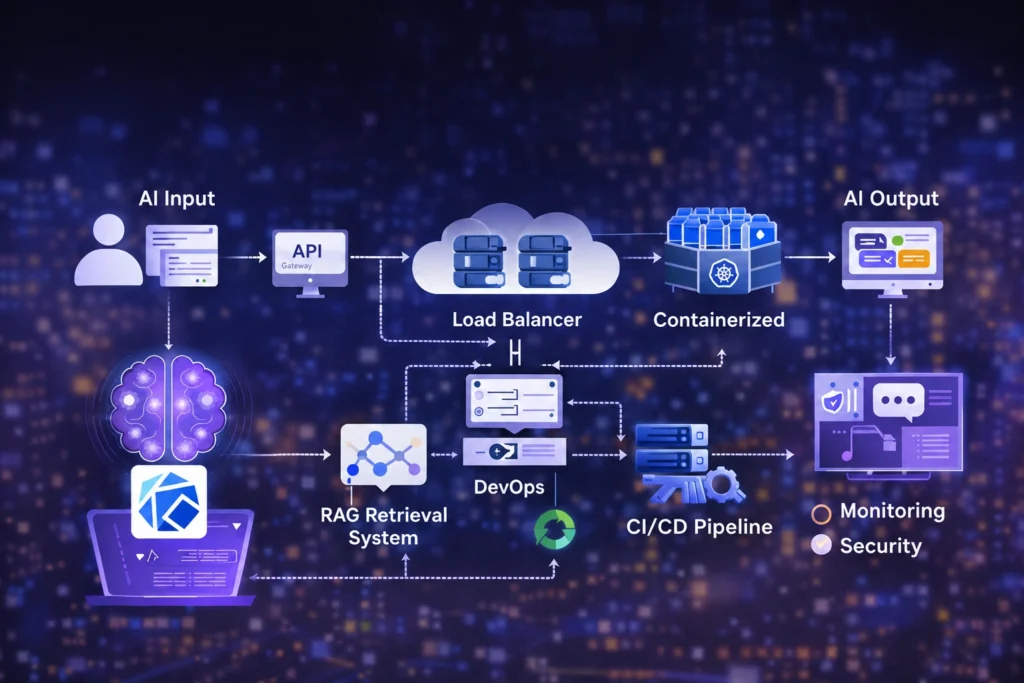
From AI Pilots to Production: A Practical Roadmap for Scaling Enterprise AI in 2026
Artificial intelligence is changing how businesses develop products, serve customers, and manage daily operations. But turning an AI experiment into a dependable business solution requires more than choosing a powerful model. Organizations need the right data, software architecture, security controls, and implementation strategy to achieve lasting results.
Introduction: The Real Challenge Is Making AI Work in Business
Over the past few years, businesses have explored generative AI through chatbots, content generation tools, coding assistants, and internal knowledge systems. These experiments have helped teams understand what AI can do and where it might create value.
However, a successful demonstration does not automatically become a successful production system. An AI prototype may work well with a small dataset but struggle with incomplete information, complex business rules, unpredictable responses, or integrations with existing applications.
The next step is to move from experimentation to implementation. Businesses need AI solutions that fit into their existing processes, protect sensitive information, deliver consistent results, and improve measurable business outcomes.
This article explains a practical roadmap for taking enterprise AI from an initial idea to a reliable, scalable business capability.
1. Start With a Business Problem, Not an AI Model
One of the most common mistakes in AI adoption is starting with technology instead of identifying the problem that needs to be solved.
A company might want to use an AI agent because the technology is attracting attention. But unless the project addresses a genuine operational challenge, it may add complexity without delivering meaningful value.
Before selecting a model or framework, identify where your organization spends too much time, encounters recurring errors, or struggles to process information efficiently.
Potential use cases include:
- Automating repetitive customer support requests.
- Extracting information from invoices, contracts, and business documents.
- Helping employees find information across internal knowledge bases.
- Classifying incoming leads and preparing sales teams for follow-ups.
- Summarizing reports and highlighting operational issues.
- Connecting separate business applications through intelligent workflows.
Choose one clearly defined problem and establish a baseline before development begins. Depending on the use case, useful measurements may include processing time, error rates, resolution time, cost per task, and employee productivity.
A focused project with measurable results is a stronger starting point than a broad initiative that attempts to automate an entire department at once.
2. Prepare Your Data and Existing Software Systems
AI systems are only as useful as the information and tools available to them. Even a capable model can produce unreliable results when business data is incomplete, outdated, inconsistent, or disconnected from the applications employees use every day.
Many organizations store information across CRM platforms, ERP systems, databases, document repositories, support tools, and custom-built applications. Bringing the right information together is often one of the most important parts of an enterprise AI project.
Before deploying AI, businesses should evaluate data quality, define access permissions, identify authoritative information sources, and determine how applications will exchange data securely.
For example, an AI assistant used by a sales team might need access to approved product documentation, customer records, and order information. It should retrieve relevant information from authorized systems rather than rely exclusively on information included in a prompt.
Depending on the application, technologies such as APIs, retrieval-augmented generation (RAG), vector search, and event-driven integrations can help connect AI capabilities to current business information.
The goal is not necessarily to replace existing software. It is to make established systems work together more effectively while maintaining data integrity and appropriate access controls.
3. Choose the Right AI Architecture for the Use Case
Not every business problem requires an autonomous AI agent or a complex multi-agent architecture. The best solution depends on how much flexibility the workflow needs, how sensitive the decisions are, and how predictable the process must remain.
AI assistants and copilots
Assistants are useful when employees need help searching information, drafting content, summarizing documents, or exploring possible solutions. They can improve productivity while keeping people responsible for important decisions.
AI-powered automation
When a process follows established rules, conventional automation combined with AI can be effective. AI can classify information or extract relevant details, while application code handles validation, routing, and predictable business logic.
AI agents
Agents can be useful when a task requires several connected actions, such as gathering information, selecting an appropriate tool, and initiating the next step. Their access should be limited to the operations required for the assigned task.
Hybrid architectures
Many production systems benefit from a combination of AI reasoning and deterministic software. The AI handles language, classification, or context-dependent tasks, while conventional services enforce permissions, validate inputs, apply business rules, and record transactions.
Selecting the simplest architecture that meets the requirements helps control development costs, improve reliability, and simplify long-term maintenance.
4. Integrate AI Into Existing Business Workflows
An AI application creates limited value when employees must leave their normal tools, copy information manually, and repeat the same steps in other systems.
To deliver practical results, AI should be integrated into the workflows where decisions and tasks already take place.
Consider a customer support process. An AI-enabled system could classify an incoming request, retrieve relevant account details, search approved documentation, draft a response, and send the case to the appropriate team. Depending on the risk and business rules, an employee might review the response before it is sent.
Similarly, an AI-enabled CRM could summarize customer interactions, identify missing information, and prepare follow-up recommendations. A finance application might extract invoice details and flag exceptions for review before an authorized employee approves payment.
These examples demonstrate why workflow design matters as much as model selection. The system must understand where a task starts, what information it needs, which actions it may perform, and how exceptions are handled.
Well-designed integrations also reduce duplicate data entry and help organizations preserve consistent records across applications.
5. Build Security and Governance Into the System
When AI systems interact with business applications, they can introduce risks that do not appear in a simple standalone chatbot. These include unauthorized data access, unreliable outputs, excessive permissions, prompt injection, and unintended actions.
Security should be part of the initial architecture rather than something added after deployment.
Important safeguards include:
- Identity and access control: Give each user and automated component only the permissions it needs.
- Data protection: Apply appropriate encryption, retention policies, and controls for sensitive information.
- Human approval: Require authorized review for high-impact or irreversible actions.
- Audit logging: Record important requests, tool calls, approvals, and system actions.
- Input and output validation: Check information before it reaches sensitive systems or triggers business operations.
- Monitoring and incident response: Detect unexpected behavior and provide a way to stop or restrict automated operations.
Organizations should also establish ownership for AI systems, define acceptable use policies, and review third-party services before connecting them to internal data.
For regulated or high-risk use cases, additional requirements may apply depending on the industry, jurisdiction, and type of data being processed.
6. Test AI Systems Beyond the Initial Demonstration
AI outputs can vary with different inputs, context, and model versions. A system that performs well in a controlled demonstration may behave differently when real users submit incomplete requests, unexpected documents, or ambiguous instructions.
Production testing should therefore cover more than whether the system works in a few successful examples.
A practical testing process includes:
- Evaluating representative real-world inputs and edge cases.
- Checking factual accuracy and whether answers are supported by approved sources.
- Testing authorization boundaries and attempts to access restricted information.
- Measuring response times, operating costs, and system reliability.
- Testing failures in external APIs, databases, and connected services.
- Comparing results against an established baseline and predefined acceptance criteria.
Where possible, teams should use automated evaluations and regression tests to detect problems after code, prompts, models, or data sources change.
Human evaluation remains important when quality depends on context, customer experience, or complex business judgment. Testing should continue after launch because production data and user behavior evolve over time.
7. Measure Business Impact After Deployment
Launching an AI feature is not the same as proving that it benefits the organization. Businesses need to evaluate whether the solution improves the process it was designed to support.
Start by defining a small set of metrics that reflect the original business problem.
- Efficiency: Time required to complete a task before and after implementation.
- Quality: Error rates, correction frequency, and output acceptance.
- Cost: Total operating cost per completed task, including model usage and human review.
- Adoption: How frequently employees use the solution and whether they continue using it.
- Customer outcomes: Resolution time, response quality, or customer satisfaction where relevant.
- Reliability: Successful task completion, failure rates, and escalation frequency.
For example, a support assistant may reduce the time required to prepare a response, but the business should also measure answer quality and the amount of human correction required. Faster output is not a meaningful improvement if employees spend more time fixing mistakes.
Review these metrics regularly and use the findings to improve prompts, integrations, workflows, and user experience. Scale the solution when the evidence supports it, not simply because the pilot has finished.
8. Scale Gradually With a Repeatable Implementation Process
Once an AI use case demonstrates reliable performance, businesses can consider expanding it to additional teams or workflows. Scaling should be a controlled process, not an immediate rollout across every department.
A practical implementation roadmap can follow five stages:
- Discovery: Identify the business problem, stakeholders, risks, and success metrics.
- Proof of concept: Validate technical feasibility with representative data and a narrow scope.
- Production development: Build secure integrations, error handling, monitoring, testing, and user controls.
- Controlled rollout: Introduce the solution to a limited group, gather feedback, and measure performance.
- Continuous improvement: Monitor results, address failures, optimize costs, and expand only when justified.
Reusable software components, documented integration patterns, centralized monitoring, and consistent security standards can make future projects easier to deliver and maintain.
Organizations should also train employees and clarify responsibilities. Successful AI adoption depends on people understanding when to trust the system, when to verify its outputs, and when to escalate a problem.
Common Mistakes Businesses Should Avoid
Even well-funded AI initiatives can struggle when implementation decisions are driven by enthusiasm rather than operational requirements.
- Automating a broken process: Improve the underlying workflow before adding AI complexity.
- Ignoring integration requirements: Plan how the system will interact with existing applications and data.
- Giving agents excessive access: Restrict available tools and permissions to the minimum necessary.
- Skipping evaluation: Test accuracy, edge cases, reliability, and security before launch.
- Measuring activity instead of outcomes: Focus on business improvements rather than the number of AI features deployed.
- Failing to plan for maintenance: Budget for monitoring, model changes, security updates, and ongoing evaluation.
A disciplined implementation approach helps businesses avoid unnecessary complexity and build AI systems that can evolve with their needs.
The Role of a Software Development Partner
Moving AI from a prototype to production often requires expertise across software engineering, cloud infrastructure, database design, API integration, security, and user experience.
A capable development partner can help assess existing systems, select an appropriate architecture, build reliable integrations, and establish the testing and monitoring practices needed for long-term operation.
For some organizations, the right starting point is a focused AI feature inside an existing application. Others may need a custom SaaS platform, an internal knowledge assistant, or an intelligent workflow that connects multiple business systems.
The best approach depends on the business requirements, available data, existing technology, and expected outcomes. A clear scope and measurable success criteria help keep development focused on solving the right problem.
Conclusion: Turn AI Investment Into Sustainable Business Value
The next stage of enterprise AI is not simply about adopting more models or building more agents. It is about making AI useful within real business operations.
Organizations that begin with clear business objectives, prepare their data, choose appropriate architectures, integrate existing systems, and establish strong security controls are better positioned to move beyond experimentation.
Just as importantly, they need to measure results after deployment and continuously improve their solutions based on actual performance.
AI creates lasting value when it helps people make better decisions, reduces unnecessary manual work, and improves the reliability of business processes. A practical, measured approach gives organizations a stronger foundation for scaling those benefits across the enterprise.
How Expoders Can Help
Expoders helps businesses build custom software, SaaS platforms, AI-powered applications, and integrated digital solutions tailored to their operational needs. From initial planning and application development to API integration and cloud deployment, the focus is on creating maintainable software that supports real business objectives.
If your organization is planning an AI initiative or looking to integrate intelligent automation into an existing product, visit Expoders to learn more about our software development services.