
Beyond AI Automation: How Intelligent Workflows Are Transforming Business Operations in 2027
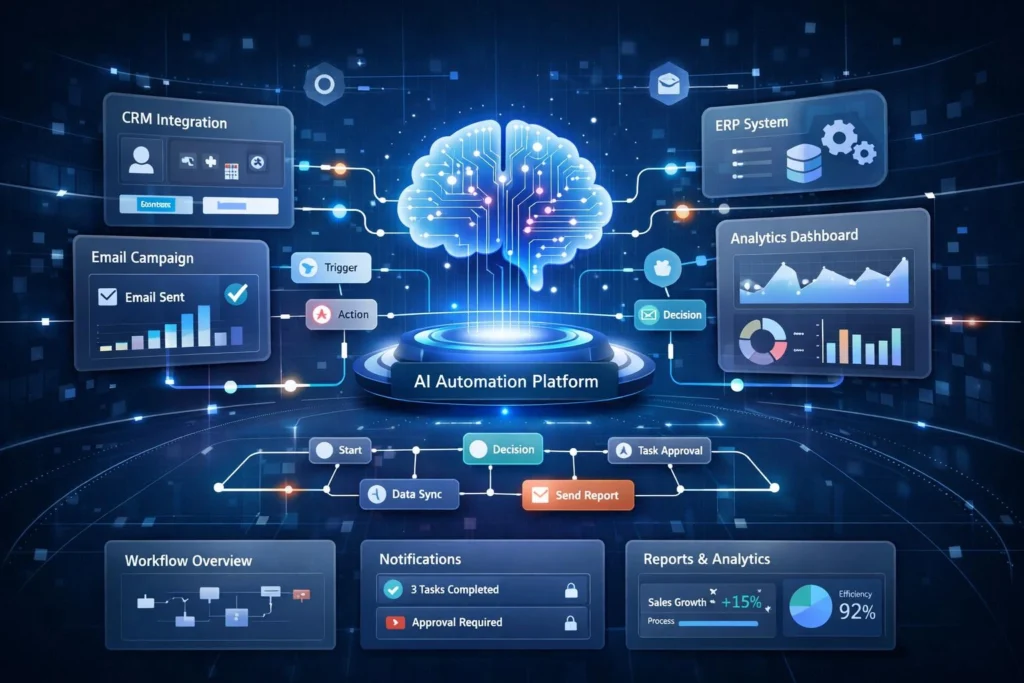
Beyond AI Automation: How Intelligent Workflows Are Transforming Business Operations in 2027
Artificial intelligence is changing how businesses operate, but the real opportunity lies beyond individual AI tools. In 2027, organizations are increasingly focused on connecting AI capabilities, business applications, company data, and human expertise into intelligent workflows that deliver measurable results.
Introduction: The Next Phase of Business Automation
Over the past few years, businesses have adopted AI-powered chatbots, content generation tools, predictive analytics, and automated customer support systems. These technologies have helped teams reduce repetitive work and access information faster.
However, introducing AI tools does not automatically transform an organization. When applications operate independently, employees still need to transfer information between systems, verify results, resolve exceptions, and coordinate tasks manually.
Intelligent workflows address this challenge by connecting people, software, data, and AI into a coordinated process. Instead of automating one isolated task, businesses can redesign how an entire operation moves from beginning to end.
According to PwC’s technology leadership insights, scaling AI requires connected data, effective governance, and alignment between technology and business strategy. This highlights why workflow design is becoming just as important as the AI technology itself.
What Are Intelligent Workflows?
Intelligent workflows are business processes that combine conventional automation, AI capabilities, connected applications, and decision-making rules to complete work with less manual intervention.
Traditional automation generally follows predefined instructions. Intelligent workflows can also interpret documents, classify requests, summarize information, identify patterns, recommend actions, and route exceptions to the right person.
For example, a traditional workflow might send an email notification whenever a customer submits a support request. An intelligent workflow could categorize the request, retrieve relevant account information, suggest a response, update the CRM, and send complex or sensitive cases to a human support specialist.
The goal is not to remove people from every process. It is to reduce unnecessary manual work while improving speed, consistency, and decision quality.
Why Businesses Are Moving Beyond Basic Automation
1. Disconnected Software Creates Operational Bottlenecks
Many organizations depend on separate systems for customer relationships, finance, inventory, project management, HR, and customer support. Although each application serves a purpose, disconnected systems can create duplicated data, delays, and inconsistent reporting.
Intelligent workflows connect these systems through APIs, integration services, shared data models, and event-driven processes. This allows information to move between departments without requiring employees to repeatedly perform the same administrative tasks.
2. Manual Processes Limit Business Growth
As a company grows, the number of customer requests, transactions, approvals, and internal handoffs increases. Processes that work for a small team may become difficult to manage at a larger scale.
Workflow automation helps businesses handle more operational activity without increasing manual effort at the same rate. Teams can focus on exceptions, customer relationships, planning, and other work that requires human judgment.
3. AI Must Deliver Measurable Business Value
Experimenting with AI can be useful, but businesses need to understand whether these initiatives improve actual performance. A successful implementation should produce measurable outcomes such as shorter processing times, fewer errors, lower operating costs, or better customer experiences.
This means organizations should begin with a clearly defined business problem rather than introducing AI simply because the technology is available.
Five Ways Intelligent Workflows Can Transform Business Operations
1. Smarter Customer Service
Customer service teams manage requests across email, websites, messaging platforms, and support portals. Intelligent workflows can classify incoming queries, retrieve relevant customer history, recommend solutions, and route complex issues to the appropriate team.
AI can also summarize previous interactions so employees do not need to review lengthy conversations before responding. Human representatives remain responsible for sensitive cases, exceptions, and decisions that require empathy or specialized knowledge.
2. Faster Financial and Administrative Processes
Finance departments handle invoices, expense claims, purchase orders, payment records, and approval requests. Intelligent document processing can extract information from invoices, compare it with purchase orders, identify potential discrepancies, and send records through the appropriate approval process.
Clearly defined rules and approval controls help organizations maintain oversight while reducing repetitive data entry. Financial transactions and unusual cases should still receive the appropriate validation and authorization.
3. More Efficient Sales and CRM Operations
Sales teams often spend significant time updating CRM records, preparing meeting summaries, qualifying leads, and following up with prospects.
Intelligent workflows can summarize sales conversations, prepare draft follow-up messages, update approved CRM fields, and notify representatives when a lead requires attention. These capabilities help sales professionals spend more time understanding customer needs and building relationships.
4. Improved Inventory and Supply Chain Visibility
Businesses that manage inventory and supply chains need timely information about demand, stock levels, supplier performance, and delivery schedules.
AI-powered analytics can identify unusual demand patterns, flag potential stock shortages, and recommend replenishment actions. When connected to inventory and order management systems, workflows can send alerts or initiate predefined processes for review.
Human approval remains valuable when decisions involve significant financial commitments, uncertain forecasts, or critical supplier relationships.
5. Better Internal Knowledge Management
Company knowledge is often distributed across documents, internal applications, project management platforms, and employee conversations. Finding the correct information can take time, especially in growing organizations.
AI-powered knowledge systems can search approved information sources, summarize relevant documents, and provide answers with supporting references. Access controls should ensure employees only receive information they are authorized to view.
The Technology Behind Intelligent Workflows
Intelligent workflows require more than an AI model. They depend on an architecture that connects business applications, manages data, executes tasks, and maintains appropriate security controls.
Artificial Intelligence and Large Language Models
Large language models can interpret natural language, summarize documents, classify requests, and generate structured outputs. When connected to approved tools and business data, they can support specific operational tasks within a larger workflow.
APIs and System Integration
APIs allow applications to exchange information and trigger actions. Reliable integrations help connect CRM, ERP, accounting, support, and other business systems without forcing organizations to replace every existing application.
Workflow Orchestration
Workflow orchestration coordinates the steps involved in completing a business process. It manages task sequences, conditional logic, retries, approvals, and exceptions so that individual services work together reliably.
Cloud Infrastructure and Data Platforms
Cloud services provide the infrastructure needed to deploy applications, process events, store information, and scale workloads. Well-designed data platforms help ensure that AI systems use relevant, consistent, and appropriately governed information.
Monitoring, Security, and Governance
Production workflows need monitoring, audit trails, access controls, and clear rules about which actions AI can perform. Organizations should track failures, review unexpected outputs, manage sensitive information, and maintain human approval for high-impact decisions.
Intelligent Workflows and AI Agents: Understanding the Difference
AI agents can be an important part of intelligent workflows, but the two concepts are not identical.
An intelligent workflow describes the broader process, including its business rules, application integrations, approvals, and monitoring. An AI agent is a component that can use a model and permitted tools to work toward a defined objective, often across multiple steps.
For example, an order management workflow might use an AI agent to investigate a delivery delay. The agent could examine authorized shipment data, summarize the likely cause, and recommend a response. The surrounding workflow would enforce permissions, record the result, and require approval before any consequential action.
Combining structured workflows with carefully controlled AI agents can offer flexibility without giving AI unrestricted access to business systems.
Common Challenges Businesses Must Address
Data Quality and Accessibility
AI-generated recommendations are only as useful as the information available to the system. Incomplete records, inconsistent formats, outdated documents, and disconnected databases can reduce reliability. Businesses should improve data quality and define trusted information sources before scaling automation.
Security and Privacy
Workflow systems may process customer records, employee information, financial documents, and confidential business data. Appropriate access controls, encryption, data retention policies, and vendor assessments are essential.
Integration With Legacy Applications
Older applications may lack modern APIs or have undocumented dependencies. Integration work may require adapters, controlled data synchronization, or gradual modernization. A practical implementation should account for existing technical limitations instead of assuming every system can be connected immediately.
Employee Adoption and Change Management
Employees need to understand how new workflows affect their responsibilities. Training, clear escalation procedures, and opportunities to provide feedback can help teams adopt automation with confidence.
Unreliable AI Outputs
AI systems can produce inaccurate answers or misinterpret unusual situations. Businesses should test realistic scenarios, validate outputs, establish confidence thresholds where appropriate, and direct uncertain or high-impact decisions to qualified employees.
How to Implement Intelligent Workflows Successfully
Step 1: Identify a High-Value Business Process
Start with a process that consumes significant time, involves repetitive steps, or experiences frequent delays. Document the current process and identify where errors, bottlenecks, and unnecessary handoffs occur.
Step 2: Define Measurable Success Criteria
Establish a baseline before implementation. Useful measures include average processing time, cost per transaction, error rates, resolution times, and employee hours spent on repetitive work.
Step 3: Review Existing Systems and Data
Determine which applications contain the required information, how they can exchange data, and what permissions are needed. Resolve critical data quality and integration issues before introducing complex automation.
Step 4: Build a Focused Pilot
Develop a small, controlled implementation around one business objective. Test normal cases, unusual inputs, integration failures, security boundaries, and situations that require human intervention.
Step 5: Measure Results and Improve
Compare the pilot results against the original baseline. Gather employee feedback, review failures, adjust workflow rules, and confirm that the solution delivers meaningful business value.
Step 6: Scale With Appropriate Governance
Expand the workflow gradually after it demonstrates reliable performance. Establish ownership, monitoring, documentation, incident handling, and regular reviews so the solution remains effective as business requirements change.
What Intelligent Workflows Mean for Businesses in 2027
The next stage of enterprise automation is not simply about adding more AI tools. It is about making technology work together to support complete business processes.
Organizations that connect their applications, improve their data foundations, and establish responsible AI controls will be better positioned to turn individual automation projects into dependable operational capabilities.
The right approach will vary by industry, company size, existing infrastructure, and business objectives. Some organizations may begin with document processing or customer support. Others may focus on connecting internal systems or improving decision-making with AI-assisted analysis.
In each case, the priority should remain the same: solve a real problem, measure the results, and expand only when the solution demonstrates value.
How Expoders Can Help
Building effective intelligent workflows requires a combination of software engineering, application integration, cloud infrastructure, and practical AI implementation. Businesses need solutions that fit their existing operations while remaining secure, maintainable, and ready to scale.
Expoders helps businesses develop custom software solutions, SaaS platforms, AI-powered applications, and integrated digital systems designed around their operational requirements.
From connecting existing applications and developing APIs to implementing AI capabilities and modernizing business software, the focus is on building solutions that address real operational challenges.
Whether a business is exploring its first AI workflow or improving an established software ecosystem, a structured implementation approach can help reduce unnecessary complexity and support sustainable growth.
Conclusion
Intelligent workflows represent an important evolution in business automation. By combining AI, connected applications, reliable data, and human oversight, organizations can improve how work moves across departments and systems.
Success depends on more than choosing the latest AI model. It requires clear business objectives, thoughtful system design, reliable integrations, strong security practices, and continuous measurement.
As businesses move toward 2027, the opportunity is to move beyond isolated automation and build connected operations that help people make better decisions, serve customers more effectively, and respond to changing business needs.