
AI Agent Sprawl: Why Businesses Need an Enterprise AI Control Plane in 2026
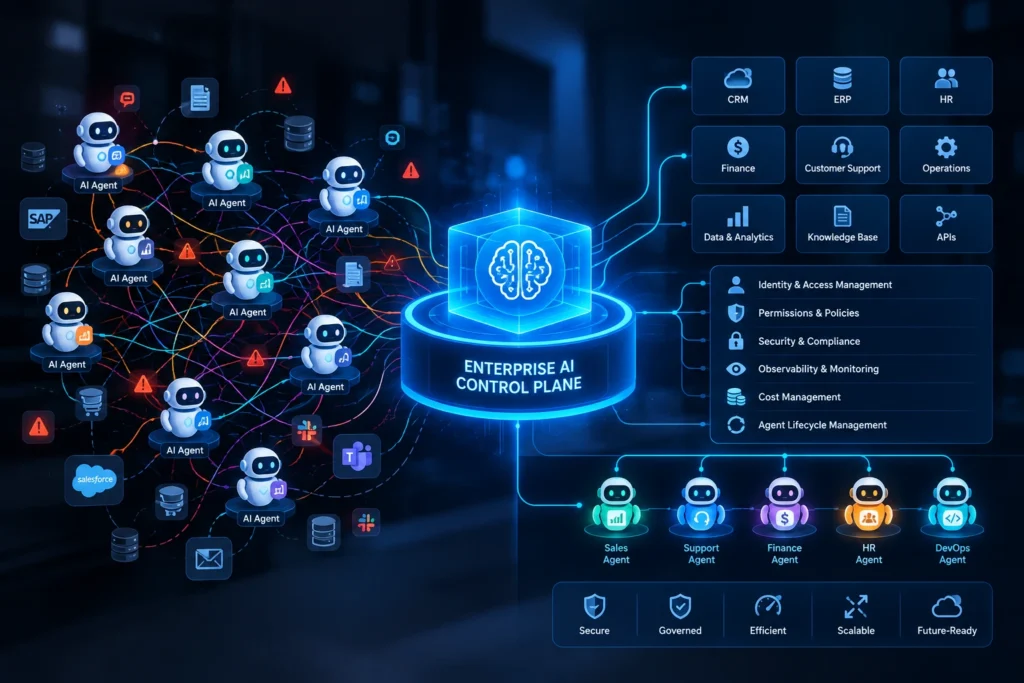
AI Agent Sprawl: Why Businesses Need an Enterprise AI Control Plane in 2026
Artificial intelligence is moving into a new phase.
Businesses are no longer using AI only through chatbots, copilots, or individual productivity tools. AI agents are increasingly being connected directly to business systems, databases, communication platforms, workflows, and operational processes.
An employee may have one AI agent handling research, another preparing reports, another interacting with customers, and another working with internal data. Different departments may deploy their own agents for sales, finance, HR, customer support, engineering, compliance, and operations.
This creates a new challenge.
The question is no longer simply how a business can build an AI agent.
The bigger question is how a business can manage hundreds or thousands of AI agents safely, efficiently, and consistently.
This is the beginning of AI agent sprawl.
As agentic AI becomes a larger part of enterprise technology, organizations need a centralized architectural layer that can manage agent identity, permissions, policies, data access, observability, security, cost, and performance.
That layer is emerging as the Enterprise AI Control Plane.
What Is AI Agent Sprawl?
AI agent sprawl happens when organizations deploy AI agents faster than they develop the infrastructure and governance required to manage them.
It can start innocently.
A sales team introduces an AI agent to qualify leads. The support team deploys another to respond to customer requests. Developers create agents for code review and testing. Finance uses AI for document processing. HR introduces an assistant for employee questions.
Each solution may provide value on its own.
The problem appears when these systems multiply.
Different agents may use different models, APIs, databases, authentication methods, permissions, monitoring systems, and security policies.
Eventually, IT teams may struggle to answer basic questions:
- Which AI agents are currently running?
- What data can each agent access?
- Which systems can an agent modify?
- Who approved the agent?
- What decisions can it make without human approval?
- How much is each agent costing the business?
- Which model is each agent using?
- What happens when an agent makes a mistake?
- Can an agent access sensitive customer or employee information?
- Can an agent trigger another agent?
- Who is accountable for an automated decision?
Without centralized control, AI adoption can quickly become difficult to manage.
Why AI Agents Are Different From Traditional Software
Traditional software generally follows predictable workflows.
A user clicks a button, the application executes predefined logic, and the system produces an expected result.
AI agents introduce another layer of autonomy.
An agent can interpret an objective, decide what actions are required, call tools, retrieve information, interact with other systems, and continue working toward a goal.
That flexibility creates enormous business potential.
It also creates a new category of operational risk.
An AI agent with access to a CRM is not simply reading information. Depending on its permissions, it could update customer records, create opportunities, send messages, or trigger workflows.
An AI agent connected to an ERP system could potentially interact with financial or operational information.
An engineering agent may access source code, repositories, cloud infrastructure, and deployment systems.
The more capable the agent becomes, the more important its identity and permissions become.
This means enterprise AI architecture must evolve beyond simply selecting the right AI model.
The Rise of the Enterprise AI Control Plane
An Enterprise AI Control Plane can be thought of as the management layer between AI agents and the organization’s systems, data, and policies.
Instead of allowing every agent to connect independently to enterprise resources, the control plane establishes centralized rules for how agents operate.
A mature control plane can manage several critical capabilities.
1. Agent Identity
Every AI agent should have a clearly defined identity.
Organizations need to know which agent is making a request, what business function it belongs to, who owns it, and what permissions it has.
This is similar to how organizations manage human users and application identities.
An AI agent should not operate as an anonymous system process.
It should have an identity that can be authenticated, monitored, restricted, and audited.
2. Permission and Access Management
Not every agent should have access to every system.
A customer-support agent may need access to customer profiles and support tickets, but it probably should not have unrestricted access to payroll or financial systems.
A software-development agent may need access to repositories and testing environments without having permission to deploy directly to production.
This is where least-privilege access becomes critical.
Agents should receive only the permissions required to complete their assigned tasks.
3. Policy Enforcement
Organizations need policies that determine what AI agents can and cannot do.
For example:
- An agent may be allowed to draft an email but not send it without approval.
- An agent may be allowed to analyze financial information but not authorize a payment.
- An agent may be allowed to modify records but only within a specific business unit.
- An agent may be allowed to execute an action automatically when the financial value is below a defined threshold.
These policies turn AI autonomy into controlled autonomy.
4. Data Access and Context Management
AI agents are only as useful as the information they can access.
However, giving agents unrestricted access to enterprise data creates significant security and privacy concerns.
A control plane can determine which data sources an agent can access and under what conditions.
It can also help manage context across systems.
For example, a sales agent may need information from the CRM, product catalog, pricing system, customer history, and support platform.
Instead of creating disconnected AI experiences, organizations can create controlled access to a unified business context.
5. Observability and Monitoring
Traditional application monitoring focuses on metrics such as CPU usage, response time, errors, and uptime.
AI agents require additional visibility.
Organizations need to understand:
- What the agent was asked to accomplish
- What information it retrieved
- Which tools it called
- What decisions it made
- Which systems it interacted with
- How long the task took
- How much the task cost
- Whether a human intervened
- Whether the final outcome was successful
This creates the foundation for AI observability.
Without it, debugging an autonomous system can become extremely difficult.
AI Agent Security Is Becoming an Identity Problem
One of the biggest changes introduced by agentic AI is the expansion of machine identities.
For years, organizations primarily focused on securing human users, applications, APIs, servers, and devices.
AI agents add another category.
An agent can act on behalf of a person or department while making decisions and executing actions autonomously.
That means security teams need to treat agents as controlled digital identities.
An enterprise architecture should be able to answer:
- Who is this agent?
- What is it allowed to do?
- What data can it access?
- Who owns it?
- What actions has it performed?
- When should it require human approval?
- What happens if it behaves unexpectedly?
These questions will become increasingly important as AI agents move deeper into business-critical workflows.
From AI Assistants to AI Workforces
The evolution of enterprise AI is moving from assistance toward delegation.
The first generation of enterprise AI primarily helped people perform tasks.
Users asked questions, generated content, summarized documents, wrote code, or analyzed information.
The next generation is more autonomous.
Businesses can define an outcome and allow AI agents to coordinate multiple steps to achieve it.
For example, consider a customer onboarding process.
A traditional workflow may require several employees to manually review information, create records, send emails, schedule meetings, and update internal systems.
An agentic workflow could coordinate many of these activities automatically.
One agent could validate customer information.
Another could prepare documentation.
Another could update the CRM.
Another could schedule onboarding activities.
A final agent could monitor the process and report exceptions.
The result is not simply one AI assistant.
It is a coordinated digital workforce.
This is where centralized control becomes essential.
The Business Case for an AI Control Plane
The purpose of an Enterprise AI Control Plane is not to slow down innovation.
It is to make large-scale AI adoption possible.
Without centralized management, every new AI initiative can introduce another integration, security policy, monitoring system, data connection, and operational process.
This increases complexity.
With a common control layer, organizations can establish reusable capabilities.
Authentication can be standardized.
Permissions can be centralized.
Policies can be reused.
Monitoring can be consolidated.
AI models can be evaluated consistently.
Costs can be tracked.
Agents can be deployed using standardized architecture patterns.
This allows teams to build faster without creating a completely different AI infrastructure for every use case.
A Practical Architecture for Enterprise AI
A modern enterprise AI architecture can be organized into several layers.
Business Applications
This is where users and business processes interact with AI.
Examples include CRM, ERP, HR, finance, customer support, healthcare, logistics, and internal business applications.
AI Agent Layer
This layer contains specialized agents responsible for specific tasks.
Examples include sales agents, support agents, finance agents, coding agents, research agents, and workflow agents.
AI Orchestration Layer
The orchestration layer determines how agents interact with models, tools, APIs, workflows, and other agents.
It can manage task routing, model selection, retries, approvals, and multi-agent workflows.
Control Plane
The control plane manages identity, permissions, policies, governance, observability, cost, evaluation, and agent lifecycle management.
Data and Knowledge Layer
This includes enterprise databases, data warehouses, document stores, vector databases, knowledge graphs, APIs, and other business information sources.
Infrastructure Layer
The underlying infrastructure includes cloud services, containers, Kubernetes environments, networking, storage, security services, CI/CD pipelines, and monitoring platforms.
This layered approach allows organizations to scale AI without turning every AI project into an isolated technology stack.
Why Data Architecture Still Matters
AI agents may be the visible part of the transformation, but data remains the foundation.
An intelligent agent cannot produce reliable business outcomes if the information behind it is incomplete, inconsistent, outdated, or inaccessible.
This is why businesses should not think about agentic AI only as an AI-model problem.
It is also a data architecture problem.
CRM data, ERP records, customer interactions, documents, analytics, operational systems, and internal knowledge need to become accessible in controlled and meaningful ways.
The better the underlying data foundation, the more useful and reliable the agents become.
Governance Must Be Built Into the Architecture
Governance cannot be added after an organization has already deployed hundreds of agents.
It needs to be part of the architecture from the beginning.
Every agent should have defined ownership, permissions, business purpose, monitoring, evaluation criteria, and escalation procedures.
Organizations should also establish clear boundaries around autonomous actions.
Some tasks can be fully automated.
Others should require human approval.
This creates a spectrum of autonomy rather than treating every AI system as either fully manual or fully autonomous.
For example:
Level 1: AI provides recommendations.
Level 2: AI prepares actions for human approval.
Level 3: AI executes low-risk actions automatically.
Level 4: AI coordinates multiple workflows with defined boundaries.
Level 5: AI operates highly autonomous business processes under continuous monitoring.
The appropriate level depends on the business process, risk, data sensitivity, and regulatory environment.
The Future of Enterprise Software Is Becoming More Agentic
Enterprise software is not disappearing.
Instead, the way people interact with it is changing.
Employees may increasingly interact with business systems through AI agents rather than navigating dozens of screens.
Instead of manually opening a CRM and updating several fields, a user may simply state an objective.
Instead of searching multiple internal systems for information, an employee may ask an enterprise agent to gather and summarize the relevant data.
Instead of manually coordinating a workflow across departments, an AI system may orchestrate the process.
This means the future enterprise technology stack will not simply consist of applications.
It will consist of applications, APIs, data platforms, AI models, agents, orchestration systems, and control layers working together.
The control plane becomes the layer that keeps all of these components aligned.
How Businesses Should Prepare for AI Agent Sprawl
Organizations do not need to deploy thousands of agents immediately.
They should start by establishing the architecture that will allow them to scale responsibly.
A practical approach includes:
- Create an inventory of existing AI tools and agents.
- Define ownership for every production AI system.
- Establish identity and permission standards for agents.
- Create reusable security and governance policies.
- Implement centralized observability.
- Track AI usage and operational costs.
- Establish human approval requirements for high-risk actions.
- Build standardized integration patterns for enterprise systems.
- Evaluate agent performance continuously.
- Create an AI architecture roadmap aligned with business priorities.
The objective is not to control every AI experiment.
The objective is to create a safe path from experimentation to production.
The Competitive Advantage Will Come From Controlled Autonomy
The companies that benefit most from agentic AI will not necessarily be the companies with the largest number of AI agents.
They will be the companies that can deploy useful agents quickly while maintaining control over data, security, costs, and business outcomes.
That requires a shift in thinking.
AI should no longer be treated as a collection of isolated tools.
It should become part of the enterprise architecture.
An Enterprise AI Control Plane provides the foundation for that transition by connecting AI agents with business systems while maintaining centralized control over identity, permissions, policies, data, observability, and governance.
As AI agents become more capable, the competitive question will move from:
“How many AI agents do we have?”
to:
“How effectively can we control and coordinate them?”
Businesses that answer that question early will be better positioned to turn agentic AI from an experimental technology into a scalable operating capability.
Conclusion
AI agent sprawl is likely to become one of the defining enterprise technology challenges of the next few years.
The number of AI agents inside organizations will continue to grow as companies automate more business processes and connect AI to critical systems.
Without a centralized architecture, this growth can create fragmented security, uncontrolled costs, inconsistent governance, and operational complexity.
An Enterprise AI Control Plane offers a different approach.
It provides the infrastructure required to manage AI agents as a coordinated part of the enterprise rather than as disconnected experiments.
For businesses planning their next stage of AI adoption, the priority should not simply be deploying more agents.
It should be building the architecture that allows those agents to operate securely, intelligently, and at scale.
The future of enterprise AI will not be defined only by smarter models.
It will be defined by how effectively businesses connect AI, data, software, people, and governance into one controlled system.